Yurii Ratushyn, Serhii Polenok
A World Without Plan B:
The Constituent of the Digital Society
Summary
From the Authors
This book was born as a response to the question that grows ever more urgent before humanity: how to survive and develop in an era of multiple crises, wars, and climate change — when the old institutions have exhausted their potential, and the new ones have not yet gained strength?
The world has found itself in a state of “connectivity crisis”: international structures created in the 20th century have lost their ability to ensure global coordination. They were effective in their time, but today they resemble an architecture no longer suited to the realities of the digital age. Within this void grows the danger of chaos, war, and the degradation of social systems.
We propose another path — not revolutionary, but evolutionary, based on the integration of law, digital technologies, and a new polycentric architecture. This concerns the formation of a Constitution of the Digital Society — without a traditional constituent assembly, but within the framework of international law and treaties, in accordance with the spirit of the Vienna Convention on the Law of Treaties. This means: not the coercion of the majority, and not authoritarian power, but a system of algorithms and polycentric institutions that create a new quality of global governance.
At the heart of this model lies the Digital Institutional Platform (DIP) — a three-dimensional, self-contained system uniting the digital person, polycentric institutions, and digital property. It mirrors a social reality capable of self-stabilization and growth. Its dynamic “constitution” evolves through a process of testing decisions in local environments. Errors here are not catastrophes — they are a resource for evolution.
Ukraine plays a special role in this process. Tested by war and crises, it has become a laboratory of new solutions. It is here that the idea emerged to create the International Hub for Sustainable Development Project Management — as a crisis-rescue platform for the world. This initiative has already gained support from the European Union, received the approval of all relevant ministries of Ukraine, and demonstrated its viability through the pilot operation of the DIP.
We see this book not merely as an academic
treatise or a collection of documents. It is a roadmap of a civilizational
project, where Ukraine acts as a catalyst of a new world order
founded on freedom, equality, and justice. This is our contribution to
the formula of universal peace:
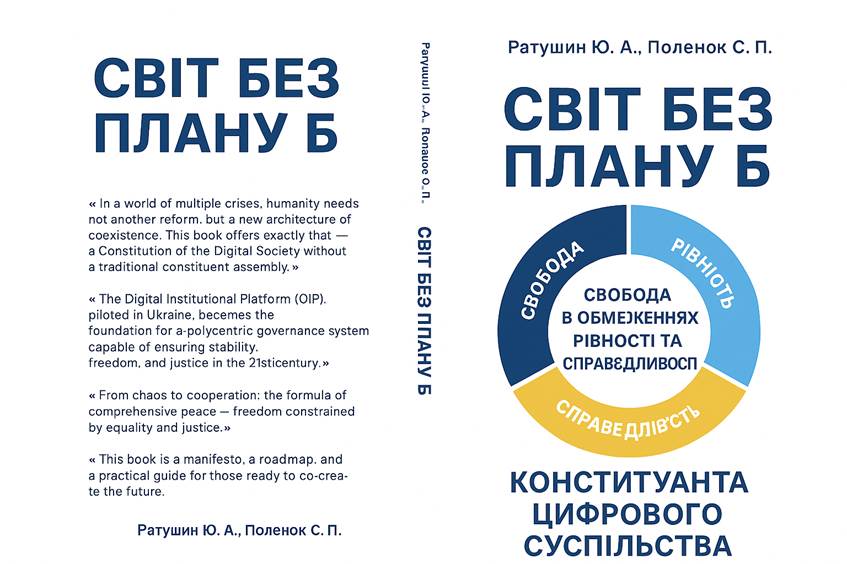
Freedom, limited by equality and justice.
Our mission is to offer humanity an architecture of trust, capable of becoming the foundation of the architecture of the future. We are convinced that only through polycentricity, digital institutions, and international law can the world emerge from the current global crisis.
This book is addressed to governments and
diplomats, innovators and entrepreneurs, philanthropists and scholars — to
all who are ready to build a new era.
It is both a call and a tool — for cooperation, for rethinking, and for
action.
Contents
From the Authors . . . . . . 8
Glossary: Definition of Terms . . . . . . 10
The Crisis of Single Connectivity: Why the World Is on the Verge of Chaos . . . . . . 16
A New Level of Interconnectedness . . . . . . 12
Governance Tools of the Digital Society . . . . . . 25
Dynamics of the Digital Economy . . . . . . 27
Generalized Model of the Dynamics of the Digital Economy of the Digital Society Considering the Passive Social Income (PSI) . . . . . . 30
Architecture of the Digital Society and the Sovereignty of the Individual . . . . . . 35
The Constituent of the Digital Society . . . . . . 40
Determining the Possibility of Creating a Constitution of the Digital Society Without a Traditional Constituent Assembly in International Law . . . . . . 42
Legal Framework: International Law on Treaties . . . . . . 37
How to Envision the Mechanism for Creating a Constitution in the Charter . . . . . . 43
Roadmap for Building a Digital Society Based on a Constitution Without a Constituent Assembly . . . . . . 46
Architecture of Digital Polycentric Institutions (DPI) in the Neuro-Polycentric Digital Institutional Platform (DIP) . . . . . . 48
Global GDP Growth . . . . . . 59
A New System of International Security . . . . . . 62
Draft Declaration on the Establishment of the International Hub for Sustainable Development Project Management . . . . . . 65
Analytical Commentary on the Declaration on the Establishment of the International Hub for Sustainable Development Project Management . . . . . . 67
Initiative for the Conclusion of an International Agreement . . . . . . 69
Draft Agreement on the Establishment of the International Hub for Sustainable Development Project Management with Commentaries . . . . . . 71
Protocol to the Agreement “Provisional Administration and Initial Financing of the Hub’s Activities” . . . . . . 141
Initiative of the Charter . . . . . . 145
International Hub for Sustainable Development Project Management: Draft Charter . . . . . . 147
Initiative (Imperative) of the Constitution of the Digital Society . . . . . . 272
Draft Constitution of the Digital Society . . . . . . 274
Implementation Management in Dialogue with ChatGPT . . . . . . 323
1. A World Without Plan B: The Challenge of Global Instability
— An analysis of the crisis of single connectivity that is destroying old institutions and creating the need for a new order.
The modern world is experiencing not merely an intensification of crises, but a qualitatively new phenomenon that can be defined as a crisis of single connectivity. By this term, the authors mean a situation in which systems that previously functioned relatively autonomously — states, markets, information networks, ecological cycles — have become so deeply interconnected that local disruptions instantly spread through the global web of dependencies. Economic shocks, information manipulation, technological failures, or military conflicts no longer remain local events: they trigger chain reactions that undermine entire institutional complexes.
In such an environment, traditional tools of governance — vertical state authority, bipolar or multipolar systems of checks and balances, classical interstate mechanisms — lose their effectiveness. They were designed for a world where problems could be localized and responses applied through centralized mechanisms of control. When a “node” in the network becomes damaged, its recovery requires coordination across the entire system — fast, transparent, and ethically grounded. The old institutional architecture lacks such tools: slow procedures, jurisdictional contradictions, and competition of interests turn into sources of additional instability.
The book emphasizes that the answer to this crisis is not a new “Plan B” of the old world — not in the escalation of power or militarization. What is needed instead is a systemic transformation of institutions — a shift from vertical hierarchies of control to networked mechanisms of harmonization, which combine ethics, law, and technology. Here emerges the idea of the Constitution of the Digital Society: not merely as a normative document, but as a system of algorithms and patterns that can be replicated throughout the network to restore balance.
The key thesis is that stability in a world of single connectivity is achieved not through the concentration of power but through coordinated responsibility — when the actions of every actor (state, community, digital person, platform) are aligned with shared ethical and legal patterns implemented through digital institutions. The Digital Institutional Platform (DIP) and Polycentric Institutions (DPI) are proposed as a practical framework for such transformation: they can provide rapid coordination, transparency of decisions, and automatic replication of ethical algorithms in moments of crisis.
Thus, A World Without Plan B is not a pessimistic diagnosis but a call for institutional and moral innovation. The crisis of single connectivity exposes the weaknesses of existing systems but also opens a window of opportunity — to build an architecture where stability arises as a property of the network itself, not as the result of dominance by a single center of power. This justifies the need for a new order — the Constitution of the Digital Society, which unites ethics, law, and technology as instruments of global resilience.
2. The Digital Society as a New Stage of Civilizational Existence
The world is entering a phase of profound transformation, where the digital society emerges not merely as a result of technological progress but as a new stage of civilizational being, transforming the nature of social, economic, and moral processes.
If the industrial era was based on mechanical interaction — physical labor,
material resources, and centralized structures of power — then the digital era
rests upon informational and ethical interaction, where the main
resources are data, consciousness, and trust.
In this context, mechanical systems, with their predictable linearity, are giving way to adaptive systems that operate through constant self-learning. This means that society is shifting from a model of governance to a model of co-adjustment, where the key mechanism is not coercion but synchronization — not command, but coordination.
From the Mechanical to the Digital Age: Changing the Nature of Power and Reality
The mechanical age was a world of centralized authority — political, economic, spiritual. Its foundation was hierarchy, ensuring order through control.
The digital age, by contrast, forms a networked structure of reality, in
which interaction occurs not vertically but through a field of continuous,
horizontal, polycentric, and complementary connections.
In such a system, power ceases to be a
monopoly — it becomes a function of trust, which can be lost or
gained in real time. Every participant of the digital network — a state, an
organization, or an individual — acts within algorithms constantly tested for
consistency with a shared ethical norm.
This marks the beginning of civilism — an era where moral logic replaces
the logic of force.
The Digital Person as a New Form of Being
Within the digital society, a new type of
subject emerges — the digital person.
This is not merely a user of technology, but an active bearer of digital
legal personality, whose identity, ownership, and ethical behavior are
encoded within digital structures — through digital contracts, identifiers,
trust profiles, and behavioral reputation algorithms.
The digital person is a fusion of the
biological and informational nature of humanity, enabling existence in a multidimensional
environment — simultaneously in physical, virtual, and neural-network
spaces.
They hold rights to property, dignity, and responsibility in digital form, and
at the same time bear full moral accountability for the actions of their
artificial intelligence, which becomes their extension rather than their substitute.
Algorithms as New Institutions
Just as laws once became tools for harmonizing
human actions within the state, in the digital world algorithms become
instruments of coordination within the network space.
However, the key difference lies in the fact that algorithms not only describe
behavior — they create it, forming new patterns of action. Hence the
need for moral algorithms — digital codes that embody principles of
ethics, justice, and balance.
Here emerges the central idea of the Constitution of the Digital Society: morality must be technically replicated.
In other words, what once existed as internal ethical intuition must be
translated into digital patterns capable of operating within the
neuro-network ecosystem.
This does not mean replacing morality with technology — rather, it signifies
its amplification: elevating morality to the level of a universal,
verifiable, and replicable structure.
Replication of Morality as the Foundation of Civilitary Order
Replications of morality are mechanisms through which ethical principles are transferred into digital actions — into contracts, into the interactions of Digital Polycentric Institutions (DPIs), into the behavior of digital persons. They form the “genome” of a new civilization, where justice and freedom no longer depend on the will of governments or corporations but are realized automatically through ethical algorithms.
Thus, the digital society becomes an ethical technology of civilization. Its core is not machinery, but the harmony between human, community, and machine — where every action carries a moral resonance. This marks the fundamental difference of the digital era: while the industrial civilization created means of production, the digital one creates means of harmony.
The digital society is therefore not merely a result of technological innovation but a stage in the evolution of human consciousness, where technology becomes not a threat but a form of expression of the spiritual principle. It does not oppose the human being to the machine — it integrates them into a single system of moral coherence. Hence, the Constitution of the Digital Society arises as the first document of a new civilizational order that unites ethics, law, and technology into a single formula: Freedom, limited by equality and justice.
Civilism as a Synthesis of Ethics, Law, and Technology
Civilism is not merely a term — it is a new paradigm of thought, born as a response to the crisis of modern civilization. It emerges at the moment when old political systems based on the primacy of force and traditional legal systems based on the will of the state can no longer ensure harmony between human, society, and technology. Civilism represents a synthesis of three foundations — Ethics, Law, and Technology, united into a single moral-digital order.
From Civilization to Civilism
If “civilization” describes the external organization of human life — cities, institutions, economy — then civilism describes its inner coherence, the moral-legal logic of shared being. Civilism marks the transition from an era of struggle to an era of co-existence — where competition for resources is replaced by co-creation of meaning, and confrontation of interests gives way to the balance of eternal values.
This transition becomes possible only when moral principles gain institutional embodiment — when ethics becomes law, and law becomes algorithm. Therefore, civilism is not a utopia but an institutional reality of the digital age, in which moral logic is technically secured and technology operates within ethical boundaries.
Three Institutions of Civilism: The Human, Property, and Eternal Values
Civilism is based on three fundamental institutions that shape the architecture of social processes:
1. The Institution of the Human — defines autonomy, dignity, and
sovereignty of the individual.
In the digital society, a human being is not an object of governance but a
subject of self-determination, capable of acting through a digital person
responsible before both community and conscience. This is the first level of
polycentricity — the individual one.
2. The Institution of Property — ensures the link between human creativity
and the results of their actions.
In the traditional world, property was material; in the digital world, it becomes
informational, reputational, or energetic — yet it retains a moral dimension:
property obliges. This institution shapes the economic neutrality of the
Digital Institutional Platform (DIP), where ownership is not a means of
dominance but a mechanism of shared prosperity.
3. The Institution of Eternal Values — freedom, equality, and justice.
These are the three ethical coordinates that form the moral gravity of the new society:
· Freedom ensures space for expression and initiative.
· Equality creates the conditions for mutual respect and access to opportunity.
· Justice serves as a balancing principle that prevents freedom from turning into arbitrariness, and equality — into coercion.
Together, they form the Formula of Universal Peace — Freedom, limited by equality and justice — the moral core of the Constitution of the Digital Society.
Integration of Ethics, Law, and Technology
Within civilism, what classical thought once considered impossible occurs: the moral and legal systems unite technically.
· Ethics no longer exists only in the realm of philosophy — it becomes an operational norm of digital systems.
· Law ceases to be an abstract text — it is implemented through algorithms of action, embedded in digital institutions (DPIs).
· Technology ceases to be an instrument of control — it becomes a mechanism of moral coordination, capable of embodying principles of justice in practical interaction.
Thus, civilism establishes an ethical-legal code of the digital civilization, where technological processes synchronize with moral coordinates. This is the core idea of the Constitution of the Digital Society: to create not merely a digital state, but a digital moral ecosystem, where harmony is a technically ensured state.
Civilism as a Legal Form of Universal Peace
Traditional international law was founded on the principle pacta sunt servanda — agreements must be kept.
Civilism introduces a higher principle — conscientia servanda — conscience
must be preserved.
This does not replace law but replicates it morally: law becomes a form
of expressing the ethical logic of humanity.
Therefore, the Digital Institutional Platform (DIP) is not merely a technological tool but the material carrier of civilism. It embodies the three institutions — the Human, Property, and Eternal Values — into a unified digital architecture, ensuring their interaction through polycentric institutions.
This allows for the creation of a new type of social contract — a civilitary-level contract, in which every action is tested for moral balance. In such a system, security, law, economy, and trust cease to exist as separate domains — they merge into a single moral-technological fabric of civilized being.
Civilism thus emerges as the new philosophy of human survival, based not on competition but on co-creation.
In it, the human being does not lose themselves in technology — rather, through
technology, they restore their moral integrity.
This is an attempt to answer the central question of the 21st century:
Can humanity remain human in the world of machines?
The answer of civilism is clear:
Yes — if morality becomes technology, and technology becomes moral.
4. The Digital Institutional Platform (DIP) — The Technological Foundation of the Constitution
Polycentric Institutions (DPIs), Neurochain, Digital Contracts, and Algorithms of Ethical Synchronization
The Digital Institutional Platform (DIP) is the foundation for the practical implementation of the Constitution of the Digital Society, transforming its philosophical principles into operational algorithmic mechanisms of governance.
If the Constitution serves as the metaphysical and legal framework of the new
social order, then the DIP is its technological body, ensuring the
functioning of a polycentric, self-regulating, and ethically balanced digital
ecosystem.
Within the DIP, a key role is played by Digital
Polycentric Institutions (DPIs) — autonomous ethical entities, each
representing a distinct vector of social or institutional life.
They do not operate as classical state or corporate structures but as neural
nodes of the collective intelligence of the digital society, maintaining
the stability and synchronization of moral, legal, and social processes.
Each DPI is not merely an organization but an algorithmic system of value governance, where decisions are formed based on the replication of ethical patterns aligned with the Principles of the Constitution of the Digital Society.
The technological core of the DIP is the neurochain
— a new generation of network protocols that combines the functions of
blockchain, neural computation, and ethical modeling.
The neurochain establishes trust without coercion, creating an
environment in which every digital action or agreement carries not only
technical but also moral and legal validation.
In this system, data are not simply stored — they evolve as living units
of meaning that sustain a state of harmonious interaction among all
participants of the digital community.
A special place in the architecture of the
DIP belongs to digital contracts — instruments that encode not only the
legal but also the ethical dimension of agreements.
They embody morally constrained freedom — the foundational principle of
digital law, where individual autonomy is balanced by the equality and justice
of other participants in the system.
As a result, digital contracts become expressions of the living action of the
Constitution, where law ceases to be coercive and instead becomes an algorithm
of trust.
To preserve harmony among different DPIs and ensure the unity of the digital ecosystem, the DIP employs algorithms of ethical synchronization.
They serve as the “moral clocks” of society, maintaining equilibrium
between the freedom of individual choice and collective justice.
These algorithms act as the digital conscience of the community,
preventing any institution or person from deviating from the foundational
values of Civilism.
Thus, the DIP emerges not merely as a tool of digital governance but as the living environment of a new civilization.
It ensures:
· Continuous moral replication of the Constitution in the digital behavior of society;
· Legal certainty without bureaucracy;
· Data security through ethical validation rather than surveillance;
· Global cooperation without loss of personal sovereignty.
Through the DIP and its polycentric institutions, the central mission of the Constitution of the Digital Society is realized — the creation of a morally governed, technologically coherent, and justly balanced world, where artificial intelligence, digital rights, and human dignity are integrated into a single system of civilitary harmony.
The DIP is not merely a technical architecture but a new paradigm of social being, where law, technology, and morality merge into a single self-regulating system.
Its significance for global order can be compared to the establishment of
international law after World War II — but within the digital dimension.
The DIP thus stands as the technological foundation of a New System of
International Security, based not on power, but on the algorithms of
ethical trust.
5. The Constituent Without a Constituent Assembly: International Law as a Platform for Creation
The methodology of forming the Constitution of the Digital Society through international treaties rather than traditional national constituent assemblies
In the traditional history of state-building, the constituent act represents an expression of popular will — the moment when a society within a defined territory adopts its Basic Law, establishing a new social contract. Yet, in the era of digital globalization, this paradigm is becoming obsolete. The Constitution of the Digital Society cannot be created within the framework of a single state, since the very notion of territorial boundaries loses its original meaning.
The Digital Society is a borderless domain in which law operates not on a territorial basis but according to the principle of digital legal personality — that is, participation of an individual or institution in the global informational and ethical space. Hence arises a new historical phenomenon — a constituent process without a constituent assembly.
This process does not require the convening of traditional constitutional conventions, nor does it call for revolutions or the overthrow of governments. Its driving force is institutional international law, which is gradually evolving from treaties between states to agreements among states, international organizations, digital institutions, and even digital persons.
Thus, instead of a national constituent assembly, a global contractual
platform emerges — where states act not as monopolists of sovereignty but
as partners in a common project of humanity’s moral evolution.
This process already possesses its legal foundation. According to the Vienna Convention on the Law of Treaties (1969), international agreements may establish new legal regimes, organizations, and institutions possessing their own legal personality.
On this basis, the International Agreement on the Establishment of the International Hub for the Management of Sustainable Development Projects was developed, together with the Draft Statute of the Hub and the Draft Constitution of the Digital Society.
These documents constitute the core of a new model of international law — contractual constitutionalism, in which the international agreement becomes a form of foundational act of global significance.
In other words, the world community is transitioning from the vertical model of “state–citizen” relations to a horizontal model of “institution–institution”, where every participant in the digital society — regardless of its legal nature — becomes a bearer of a portion of global sovereignty.
Three Levels of the New Constitutional Order
1. International Level — The Agreement serves as the legal foundation of the common space and as a guarantor of coordination among states.
2. Institutional Level — The Statute of the Hub acts as a normative model of polycentric governance, where digital institutions interact through ethical algorithms.
3. Digital-Ethical Level — The Constitution functions as a source of moral law, ensuring the balance of freedom, equality, and justice within the digital dimension.
This transition signifies the emergence of a new methodology of the constitutional process, in which legitimacy no longer requires national ratification but is formed through the consensus of global actors who recognize common principles of digital law. Accordingly, the Constitution of the Digital Society is not an act of coercion but a contractual declaration of ethical consent, through which each participant affirms belonging to the civilitary order via digital identification.
It is important to note that this process does not negate international law; rather, it elevates it to the level of meta-law, wherein treaties acquire the nature of “ethical codes of civilization.” In this sense, the International Agreement on the Establishment of the Hub serves as a modern form of global constituent act — where, instead of delegates, there are states; instead of voting, there is electronic ratification; and instead of political power, there are harmonized algorithms of moral governance.
Legal and Philosophical Foundations
· It realizes the principle of inclusive sovereignty, whereby the right to participate in shaping global order belongs not only to states but also to civic, scientific, ethical, and digital structures.
· It ensures fiscal neutrality and independence of the Hub as a new subject of international law.
· It establishes an institutional mechanism of sustainable peace, in which security is based not on the balance of power but on the balance of ethical replications.
Thus, the Constituent Without a Constituent Assembly is not a rejection of democratic processes, but their evolution to a planetary level, where lawmaking becomes a function of consciousness rather than authority.
In this new legal field, digital ethics becomes part of international law, and
the Constitution of the Digital Society represents the first global
attempt to harmonize humanity not through coercion and control but through the algorithmic
harmony of ethical choice.
The Constituent Without a Constituent
Assembly is therefore a model of a new form of legal legitimacy, in
which the source of constituent power is not the nation but humanity as a
whole.
Its implementation through international treaties allows for the creation of
global institutions without geopolitical dominance, while preserving the
supremacy of ethical principles.
This transformation opens the way toward a new system of international
security, where the ultimate guarantor of peace is not the might of states
but the shared moral architecture of the digital civilization.
6. Draft International Agreement on the Establishment of the Hub
Key
Provisions of the Initiative for the International Hub Agreement: Objectives,
Mechanisms, Powers, and the Role of States and Digital Institutions
(Agreement Initiative Text)
The International Agreement on the Establishment of the International Hub for Sustainable Development Project Management represents the world’s first experimental legal instrument that integrates the principles of sustainable development, digital economy, ethical governance, and the new system of international security into a single contractual framework.
It serves not merely as a political document, but as an institutional constitution of global interaction — forming the foundation for a transition from an era of geopolitical competition to an era of civilitary coexistence: a shared existence of states, digital institutions, and citizens within a unified moral-digital space.
Institutional and Legal Context of the New International Order
The Agreement was initiated by the Charitable Foundation “International Security and Sustainable Development”, which serves as the depositary and guarantor of the ethical compliance of the project.
Its structure and content are aligned with the Vienna Convention on the Law
of Treaties (1969), establishing the legal framework for the conclusion and
implementation of intergovernmental agreements and the creation of new
international organizations.
Moral-Legal Context of the New Global Order
The Preamble lays the ethical foundation for establishing the Hub — not as another technical or financial body, but as a new-type institution combining moral, legal, and institutional dimensions of development governance.
It acknowledges that humanity has entered a phase of global transformation, where traditional mechanisms of security, economy, and ecology can no longer ensure sustainability. Hence, a new level of coordination is required — one based not on power but on ethics, not on control but on coherence.
The Preamble defines the key objective: the creation of the Digital Institutional Platform (DIP) as a techno-legal environment for coordinating international projects, sharing resources, digital assets, and ethical algorithms of cooperation.
Through the DIP, the principles of the Constitution of the Digital Society
are implemented in the practical domain of global governance.
Objectives of the Hub: Institutionalizing Sustainable Development through Digital Governance
Article II of the Agreement outlines the comprehensive objectives of the Hub, integrating legal, technological, and civilizational dimensions:
1. Promoting Sustainable Development — by coordinating international programs of the UN, EU, African Union, and other structures based on transparent algorithms of accounting, planning, and monitoring.
2. Institutionalizing the Digital Space — by creating a new legal architecture for the digital economy, where digital property, digital persons, and digital institutions are recognized as subjects of international law.
3. Developing a New System of International Security — by forming a framework of ethical balances that prevent conflicts and ensure coordination of intergovernmental and transnational actions.
4. Implementing the Digital Institutional Platform (DIP) — by building a network of Polycentric Institutions (PIs) operating through a neurochain, ensuring decentralized and ethically synchronized governance.
All these objectives are realized through the principle of soft constitutionalism — a form of constitutional cooperation that does not impose political authority but creates conditions for collective alignment based on trust, transparency, and moral consensus.
Mechanisms of Functioning: Polycentric Governance
The Hub has no central governing authority in the classical sense.
Its structure is based on a Council of Governors, a collegial body
empowered to:
· Adopt the Statute of the Hub without requiring further ratification by the States;
· Approve the Principles (Constitution) of the Digital Society;
· Coordinate the activities of the Secretariat, performing operational and analytical functions;
· Allocate resources and profits, including the digital financial accounts of individuals within the DIP system;
· Define the rules of digital property, asset tokenization, project participation, and interaction with state institutions.
Thus, the Council of Governors serves as the moral and legal nucleus aligning decisions among States, international organizations, research centers, digital institutions, and civil society.
Participation of States and Digital Institutions
The Agreement provides for open accession by any State, international organization, or legitimate digital entity.
States may join the Agreement through ad referendum signature or by depositing a Declaration of Legal Personality (sample included in the annexes).
At the same time, Polycentric Digital Institutions (PDIs) obtain the
status of associated participants, entitled to propose projects,
participate in program commissions, implement technological solutions, and be
part of the ethical neurochain network.
This model ensures that States do not lose sovereignty but rather delegate part of their coordination functions to a shared institution that operates within an ethical and technically neutral framework.
Immunities, Privileges, and Fiscal Neutrality
A special provision of the Agreement (Article
X¹) establishes the principle of fiscal neutrality.
Projects implemented under the auspices of the Hub enjoy immunities,
guarantees, and tax exemptions until they are transferred to State
authorities or institutions receiving the final benefit.
This provides a legal foundation for effective international investment, prevents dual jurisdiction and corruption risks, and ensures transparency of financial flows through the DIP system.
Such a provision aligns with international practice applicable to organizations like the UN, IBRD, or EBRD, but is complemented by digital control mechanisms — ethical neurochain algorithms that automatically verify the legitimacy of all transactions.
Ethical Function of the Hub: Coordination Instead of Control
Unlike traditional international institutions operating through bureaucratic systems, the Hub functions through ethical algorithms — digital interaction systems reflecting the principles of Freedom, Equality, and Justice.
Thus, instead of command-and-control management, a mechanism of moral equilibrium emerges, where decisions are made based on ethical coherence among digital institutions rather than coercion.
This represents the core innovation of the Agreement — the creation of a moral-technological mechanism of global coherence, where the Constitution of the Digital Society becomes not merely a declaration but an operational code of conduct for the digital civilization.
Significance for International Law
The draft International Agreement on the Establishment of the Hub marks the first step toward forming a new system of international law — the law of global ethics.
It combines the principles of the Vienna Convention (treaty as a source of obligations between subjects of law) with elements of digital constitutionalism, where subjectivity extends beyond States.
The Hub thus becomes a bridge between
classical international law and the digital world — between norms and moral
algorithms, between humanity and its digital replicas.
Its creation represents not a mere political act but a civilizational
gesture of alignment, shaping a new format of coexistence on the planet.
The Agreement stands as the first
historical example of an international treaty functioning not as a tool of
political coordination, but as a mechanism of moral self-governance of
humanity.
Through it, the global community transitions from the competition of
sovereignties to the harmony of responsibilities, making the Hub a
prototype of a new stage in international law — the law of civilism,
where legitimacy derives not from power but from the shared ethical will for
peace and sustainable development.
7. Draft Charter of the Hub: Structure and Governance Mechanisms
— Overview of the main provisions of the Hub Charter Initiative: organs, powers, interaction with the Digital Institutional Platform (DIP), rules for accession and withdrawal.
— Reference to the full text of the Charter (see “Charter Initiative”) at c3n.info.
The Charter as a Constitutional Model for Governance in the Digital Era
The Draft Charter of the International Hub for Sustainable Development Project Management is not merely an organizational regulation — it represents a structural matrix for a new model of global governance, where states, institutions of the digital society, and private initiatives interact.
Its core mission is to establish a decision-making mechanism that balances political
sovereignty of states with technological sovereignty of digital
platforms, as well as the right to self-determination with collective
responsibility toward humanity.
Like the Constitution of the Digital Society, the Hub Charter serves as an institutional bridge between international law and the digital polycentric system. It does not replace state jurisdictions but creates a space for supranational cooperation — flexible, open, and adaptive.
Its principal innovation lies in the fact that the Charter does not require
parliamentary ratification by member states; it enters into force through a
decision of the Governing Council, reflecting the evolution of
international law into its digital phase — from a centralized to a polycentric
order.
Structure of the Hub: Polycentric Governance and Ethical Synchronization
The main bodies of the Hub are:
1. Governing Council — a collegial political body that makes strategic decisions, approves the budget, defines project priorities, and adopts key documents (including the Principles – Constitution of the Digital Society).
2. Hub Secretariat — the executive body coordinating programs, managing the Digital Institutional Platform (DIP), and ensuring ethical synchronization of decisions through the algorithms of Polycentric Institutes (CPIs).
3. Polycentric Institutes (CPIs) — autonomous digital organizations implementing specific sustainable development directions, from climate programs to DIP financial models. Their activity is based on the principle of digital subsidiarity: decisions are made at the lowest possible level where they can be implemented most effectively.
4. Digital Ethics Council — a consultative body ensuring that all digital processes comply with the moral patterns of Freedom, Equality, and Justice.
The Hub’s decision-making mechanism combines elements of classical diplomacy and artificial intelligence: digital contracts guarantee the implementation of agreements, while the neurochain ensures transparency and reproducibility of actions — creating a new quality of governance: algorithmically verified trust.
Interaction with the DIP Charter: Legal and Technological Integration
The Hub Charter is directly linked with the Digital Institutional Platform (DIP), which serves as its technological foundation. Through the DIP, the following functions are implemented:
· Registration of digital persons and institutions;
· Accounting and protection of digital property;
· Tokenization of assets and distribution of profits from joint projects;
· Management of cross-border contracts and financial flows.
Thus, the Hub operates not only as an international organization but also as a digital legal ecosystem, where every participant has a unique identity, rights, duties, and algorithmically recorded guarantees.
This forms a unique digital jurisdiction — a space where norms of
international law and technological standards merge into a single legal code.
Conditions for Participation and Withdrawal: Openness and Neutrality
The Hub is based on the principles of open participation, institutional neutrality, and fiscal autonomy.
Any state, international organization, or digital institution may join by
submitting a Declaration of Accession to the Charter.
Withdrawal is also allowed without sanctions, provided that all ongoing
projects are completed or transferred to successor institutions.
A special regime of immunity applies to Hub projects: until their results are transferred to state authorities, they are exempt from taxation and enjoy legal protection similar to that of international missions.
This ensures a safe environment for innovative development, free from political
or bureaucratic barriers.
The Hub Charter is a key legal mechanism
for transforming international law into its digital form.
Its concept is founded on polycentric governance, combining humanitarian
and technological approaches.
Through it, the global system transitions from state sovereignty to institutional
sovereignty — human, digital, and ethical.
In a historical perspective, this resembles the adoption of the UN Charter in 1945, which established the foundations of the post-war legal order.
Now, in the age of digital civilization, the Hub Charter Project may
play a similar role — becoming the legal architecture of a new world order,
where international law, artificial intelligence, and ethics coexist not
as rivals but as complementary forms of global rationality.
Further details are available in the “Charter Initiative” section at c3n.info.
8. Draft Constitution of the Digital Society
— Ethical, legal, and technological architecture of the Constitution: patterns, algorithms, responsibility, and the balance of Freedom, Equality, and Justice.
— Reference to the full text of the Constitution (see “Constitution Initiative”) at c3n.info.
The Constitution as an Ethical Code and Technological Algorithm of Civilizational Development
The Draft Constitution of the Digital Society is not merely a normative document — it is an attempt to create a universal code of ethical, legal, and technological existence for humanity in the digital age.
While a classical constitution defined the limits of political power within a
state, the digital Constitution defines the limits of influence of artificial
intelligence, algorithms, and digital systems within the global social
sphere.
Its mission is to establish a new architecture of civilizational order in which
morality, law, and technology act not separately, but synchronously.
The Constitution of the Digital Society defines three levels of being:
1. Ethical — the level of values that guide behavior (Freedom, Equality, Justice).
2. Legal — the level of norms regulating digital interactions, rights, and duties of digital persons.
3. Technological — the level of algorithms that ensure compliance with norms and reproduce moral patterns through digital behavior.
Thus, the digital Constitution functions as a system of ethical self-regulation operating through technological mechanisms.
It does not impose morality on humans but creates conditions in which morality
becomes technologically reproducible, and ethics become algorithmic.
Architecture of the Constitution: From Patterns to Algorithms
The structure of the Digital Society Constitution consists of three interconnected modules:
1. Patterns — foundations of civilitary thinking.
These are universal behavioral schemas rooted in natural morality and civilism. Patterns act as the ethical “neurons” of society, preserving the eternal reference points of human nature — Freedom, Equality, and Justice.
2. Algorithms — instruments of digital responsibility.
Ethical synchronization algorithms ensure the automatic alignment of human or digital actions with fundamental moral norms. They are codes of trust, transforming ethical principles into the digital logic of behavior.
3. Replications — mechanisms for spreading ethical culture.
In the digital society, replications are the ways moral models propagate through neurochains, CPIs, and digital persons. They ensure the continuity and reproducibility of moral order without the need for centralized control.
This triadic structure — ethics, law, and technology — makes the Constitution not just a text, but a living system adaptable to new technological and cultural conditions.
Responsibility and Balance: Freedom, Equality, Justice
The key principle of the Constitution is the formula of ethical balance:
Freedom, limited by Equality and Justice.
Freedom in the digital society is not arbitrariness but a space for self-realization, bounded by two symmetrical constraints: equality of access to digital opportunities and justice in the distribution of outcomes.
Equality does not eliminate diversity; it guarantees equal starting conditions
for creativity. Justice functions as an ethical correction mechanism,
preventing domination by algorithms or individual interests.
This triangle of values forms the matrix of moral resilience for civilization. It ensures that technological progress does not become a new form of oppression but serves as a tool for humanizing the global order.
The Constitution as an International Act: From States to Digital Communities
The Digital Society Constitution has
both supranational and institutional character.
Its provisions do not require ratification by national parliaments — they
operate within the framework of the International Hub and the Digital
Institutional Platform (DIP) as a shared ethical code for states,
organizations, and digital persons.
Thus, the digital Constitution becomes the world’s first trans-legal system, integrating norms of international law, moral principles, and algorithmic governance practices. Its function is to serve as the moral-legal core of a new system of international security — where conflicts are replaced by ethical coordination, and wars by informational peacebuilding processes.
The Constitution of the Digital Society is a constitution without a constituent assembly — it arises not from political deliberation but from ethical-technological consensus. It is a document that not only codifies new rights but also defines a new ontology of the human being — one’s digital reflection and one’s responsibility to oneself, to property, and to eternal values.
In a broader sense, this Constitution
articulates the philosophy of the digital era in legal form.
It opens the path to a new type of citizenship — digital citizenship, where
individuals not only exercise rights but also participate in shaping the
ethical algorithms of society.
Thus, the Digital Society Constitution is an architecture of trust, built upon the unity of ethics, law, and technology. It not only responds to the challenges of digital civilization but also sets the direction for humanity’s evolution — from competition to co-tuning, from subordination to ethical synchronization.
Further details are available in the “Constitution Initiative” section at c3n.info.
9. The New System of International Security: From the Balance of Power to the Balance of Ethics
— The role of CPIs, the Hub, and the Constitution in ensuring global order without centralized coercion.
Transformation of the Security Concept in the Digital Age
The classical system of international security was based on the balance of power: states maintained stability through armies, alliances, and control over resources. Such an approach has proven ineffective in a globally interconnected world, where information, capital, and technology spread instantaneously, and the boundaries between internal and external security have become blurred.
The new system of international security proposes a fundamentally different approach — a balance of ethics and digital institutions. Here, security is determined not by force-based confrontation, but by the harmonization of actions among states, digital communities, and institutions within the ethical algorithms enshrined in the Constitution of the Digital Society.
This shift means that sustainable order arises through the alignment of behavioral norms rather than the dominance of some actors over others. As a result, the likelihood of conflict diminishes, since the mechanisms for resolution are embedded within the very structure of interaction rather than dependent on external instruments of coercion.
The Role of Digital Polycentric Institutions (CPIs)
CPIs act as ethical regulators and coordinators of interaction among states, organizations, and digital persons. They perform the following key functions:
1. Forecasting and crisis prevention. CPI algorithms analyze global processes and anticipate potential conflicts or destabilizing trends.
2. Establishing ethical standards. Through digital patterns, CPIs define behavioral norms for all participants in the system.
3. Restoring balance. In cases where agreed-upon rules are violated, CPI algorithms automatically initiate corrective mechanisms without the need for coercive intervention.
Thus, CPIs replace the vertical structure of enforcement with a horizontal network of responsibility and trust.
The Hub as a Central Coordination Platform
The International Hub for Sustainable Development Project Management serves as a global platform for interaction between CPIs and states, ensuring:
· the alignment of strategies and policies in both digital and physical domains;
· the coordination of transnational sustainable development projects;
· the integration of legal, ethical, and technological standards within the Digital Institutional Platform (DIP).
The Hub functions not as an authority, but as an instrument of ethical synchronization, guaranteeing adherence to the principles of the Constitution of the Digital Society within international relations.
The Constitution as the Core of the New Security System
The Constitution of the Digital Society provides the normative and ethical foundation upon which the entire system rests. It:
· defines the rights and duties of digital persons and states within the global space;
· embeds algorithms for balancing freedom, equality, and justice;
· enables the replication of moral and legal norms through neurochains and digital contracts.
Thus, security no longer depends on force or armament, but on the capacity to align the behavior of actors through ethical and technological mechanisms.
From Balance of Power to Balance of Ethics
The new system of international security demonstrates that stability in the digital age is impossible without the integration of law, ethics, and technology.
It represents a transition from a mechanical balance of power to a dynamic
balance of ethics, where every participant in the system not only fulfills
its functions but also bears responsibility for the reproduction of moral
order.
Within this model, Ukraine and other
nations may serve as equilibrium points — testing grounds for the Digital
Institutional Platform (DIP) and the Hub as instruments of global
stabilization.
This opens the path toward comprehensive peace, where conflicts are
prevented through transparent algorithms of interaction rather than through
threats or coercion.
10. Impact on International Law and Precedent Models
— How international treaties, customary law, and legal principles can integrate this Constitution; connection with the Agreement on International Arrangements.
— Reference to international law: treaties as a form of codifying obligations
between states (as defined by the Vienna Convention on the Law of Treaties)
[treaties.un.org+1].
The Constitution of the Digital Society in the Context of International Law
The Constitution of the Digital Society introduces a new level of legal harmonization at the global level, where digital institutions, the Hub, and states can interact within a normative-ethical platform. Integrating such a Constitution into international law involves utilizing existing mechanisms of legal obligation:
1. International treaties and agreements. The Constitution can be codified through multilateral treaties, similar to how states conclude agreements on environmental protection, trade, or security. This aligns with the definition of treaties in the Vienna Convention on the Law of Treaties (1969), which defines a treaty as “an agreement between states which is governed by international law and establishes their rights and obligations” (treaties.un.org).
2. Customary international law. Behavioral patterns of CPIs and digital persons can form precedent norms that, over time, become part of customary law. For example, the regular use of digital contracts in transnational Hub projects could establish interaction rules recognized by the international community.
3. Legal principles. The concept of algorithmic justice and the balance of freedom, equality, and fairness can serve as a universal standard, integrating into international instruments as a moral-legal compass for dispute resolution and alignment of actions.
Precedent Models
When considering international precedents, several models illustrate how the new Constitution can be integrated:
· Multilateral agreements (such as the Paris Climate Agreement), where participants commit to adhere to agreed standards and reporting requirements. Similarly, digital institutions and the Hub can conclude agreements on ethical and legal standards for the digital society.
· International organizations, such as the UN or the World Trade Organization, demonstrate that institutional frameworks can ensure compliance without direct coercive instruments, analogous to the role of CPIs in the digital system.
· International codes of conduct that evolve into customary law, e.g., the UN Cybersecurity Code. Likewise, the patterns of the digital Constitution can become ethical and legal standards of interaction across the global network.
Connection with the Agreement on International Arrangements
The initiative of the International Hub, as described in the Agreement Project (Agreement Initiative), demonstrates practical implementation of the Constitution’s principles:
· States and digital institutions sign an agreement codifying rights, obligations, and governance mechanisms;
· The agreement defines the powers of the Hub, its interaction with the DIP, and state participation, creating a legal framework for the further development of digital norms;
· This approach allows the Constitution to become an integrated element of international law without a traditional constituent assembly, utilizing the mechanisms of treaties and customary law.
This approach shows that international law can evolve alongside digital technologies, integrating new forms of legal personality and ethical standards. The Constitution of the Digital Society does not contradict existing norms of international law but uses them as a platform to legitimize and implement a global system of digital security and cooperation.
Summary – Conclusion
The book “A World Without Plan B: The Constituante of the Digital Society” is a fundamental work combining philosophical, legal, and technological analysis of the global crisis and offering concrete institutional solutions for establishing a new civilizational order. The authors demonstrate that traditional institutions—states, financial systems, international organizations—have exhausted their capacities in a globally interconnected world where information flows rapidly.
Key Contributions of the Book
1. Conceptualization of the Digital Society as a New Stage of Civilizational Being
· For the first time in scholarly literature, digital persons, algorithms, and moral replications are systematically presented as the foundations of a new social organization.
· The book shows that the digital society is not merely about technology, but a new ethical-legal space where freedom, equality, and justice are algorithmically embedded.
2. Development of the Digital Institutional Platform (DIP) and Digital Polycentric Institutions (DPIs)
· These form the technological and organizational basis for new forms of governance, enabling global projects—including international Hubs for sustainable development—without the need for vertical control.
· Proposed mechanisms, such as neurochains, digital contracts, and ethical synchronization algorithms, provide practical tools for implementing the Constitution of the Digital Society.
3. Initiative of a Constitution Without a Traditional Constituent Assembly
· The authors demonstrate that international law and multilateral treaties can serve as a platform for establishing a global Constitution of the Digital Society.
· For the first time, a concrete legal methodology is proposed to codify ethical and technological patterns in international treaties and the Hub Charter.
4. Practical Implementation Projects
· The International Agreement on the Creation of the Hub, the Hub Charter, and the Draft Constitution of the Digital Society demonstrate how theoretical principles can be translated into legal, organizational, and technological instruments.
· These projects create precedent models for integrating digital norms into international law and enable governance of global sustainable development projects.
5. New System of International Security and the Formula for Comprehensive Peace
· The book proposes an alternative to the classical balance of power, replacing it with a balance of digital institutions and ethical algorithms.
· The formula “Freedom limited by Equality and Justice” becomes a foundation for future international agreements and the global order.
6. The Ukrainian Civilizational Project as an Example of Global Transformation
· Ukraine emerges not only as a participant in global processes but as a laboratory of digital civilizational development, testing new DIP mechanisms and implementing the Hub’s international initiative.
· This provides practical validation of the theoretical models proposed by the authors.
Conclusion
The book is a unique integration of theory and practice, combining:
· Deep analysis of contemporary global crises;
· Conceptual foundations of the digital society and civilizational ethics;
· Practical tools for implementing the new Constitution through international law and digital institutions.
The authors have created a new model of global cooperation that unites ethics, law, and technology, opening the path to systemic, peaceful, and stable civilizational development in the digital age.
The significance of this work lies not only in its academic novelty but also in its practical relevance for international political decision-making, digital initiatives, and the formation of future global standards.