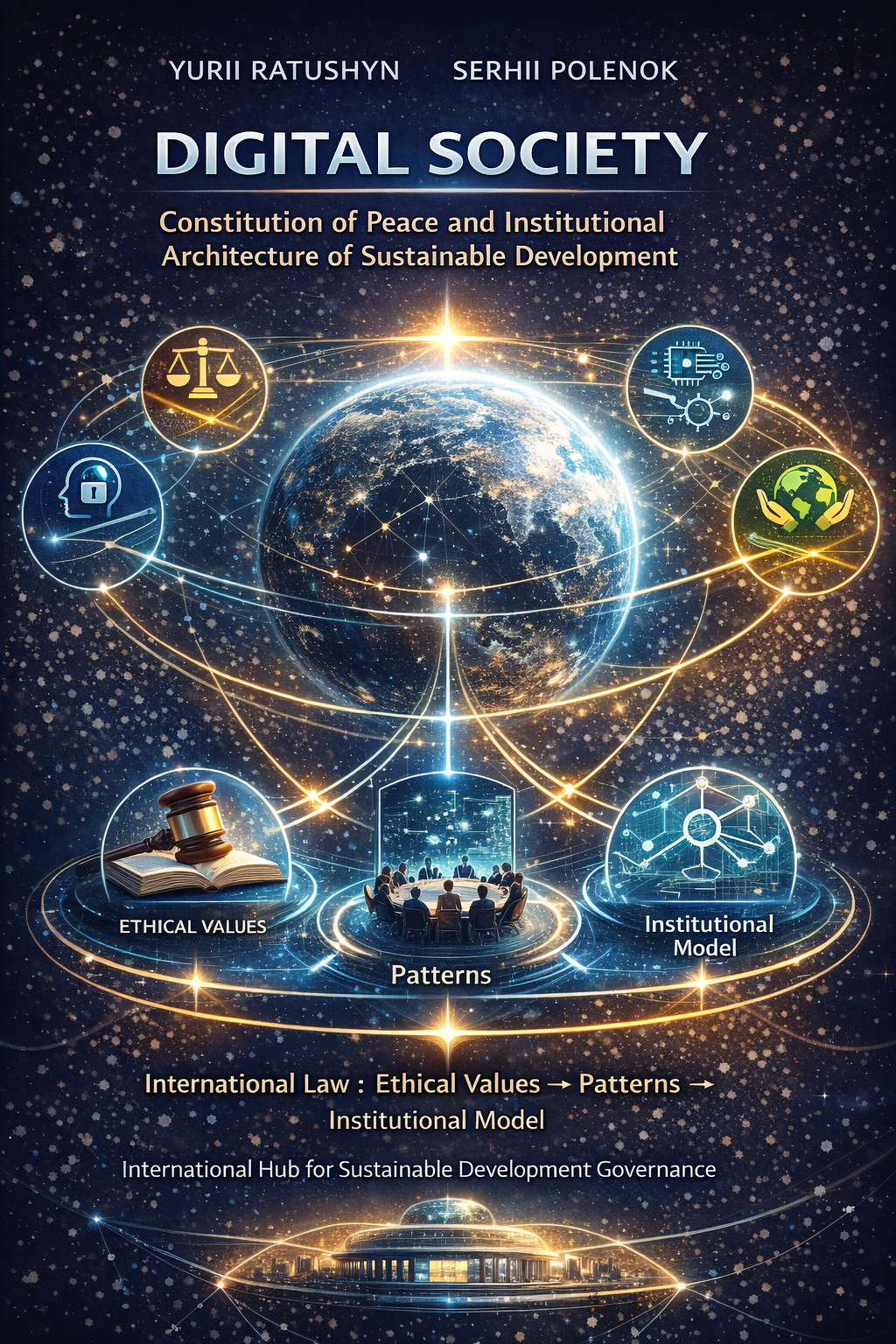
Digital Society: Constitution of Peace and Institutional Architecture of Sustainable Development
Authors: Yurii Ratushyn • Serhii Polenok
Summary
The book proposes a new civilizational model for the development of humanity in the digital era. It argues that the current international system, based on geopolitical competition and industrial-era institutions, is unable to effectively address global challenges such as wars, climate threats, economic instability, and the growing crisis of governance.
The authors present a conceptual transition from a system of geopolitical confrontation to a system of institutional cooperation built on digital technologies, ethical values, and polycentric governance.
The Core Idea
The foundation of the new model is the creation of a Digital Institutional Platform (DIP) that enables the development of a global digital society. Within this system, individuals, institutions, states, and international organizations interact through transparent digital rules, ethical algorithms, and institutional patterns.
Digital society is not merely a technological upgrade of existing institutions. It represents a fundamentally new structure of social relations where governance, economy, and law operate through decentralized and polycentric institutional mechanisms.
Key Principles
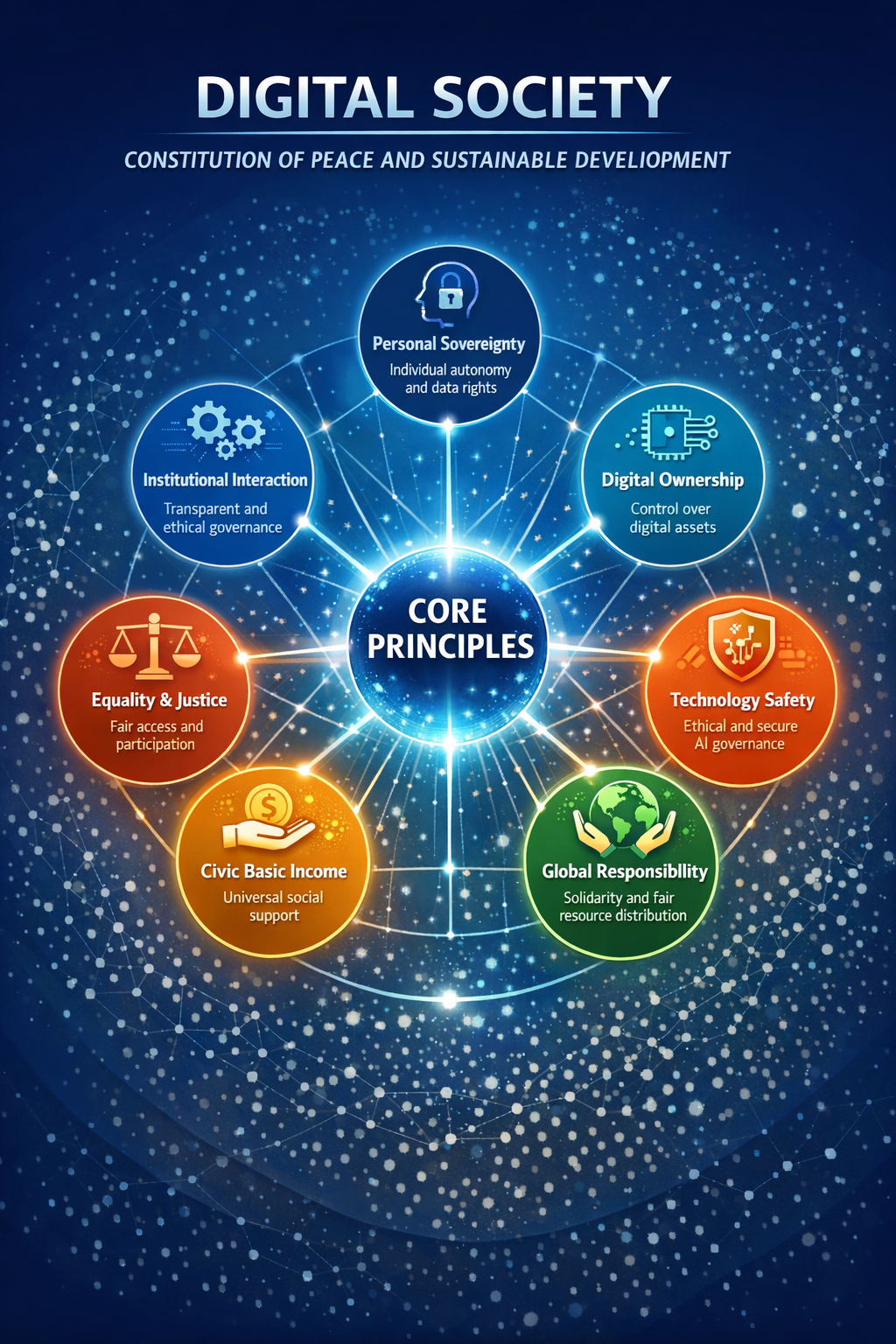
- Human sovereignty in the digital environment
- Institutional polycentricity and global collaboration
- Ethical patterns embedded into digital governance
- Digital property and digital legal relations
- Transparency and accountability through digital infrastructure
Freedom, Equality and Justice
The conceptual formula of peace in the digital era is based on three interdependent principles:
- Freedom — open access for every person to the digital market and institutions of the Digital Institutional Platform.
- Equality — every participant possesses their own Digital Polycentric Institution, ensuring equal participation in economic and social processes.
- Justice — the implementation of Civic Passive Income, which redistributes part of the value generated by the digital economy to all members of society.
These principles transform classical political values into operational mechanisms of digital governance.
The International Hub
The practical implementation of this model is proposed through the creation of the International Hub for Sustainable Development Project Management.
The Hub functions as a coordinating institution that connects governments, businesses, civil society, and digital institutions in order to implement large-scale sustainable development projects.
Through the Digital Institutional Platform, the Hub enables global cooperation, resource mobilization, and the deployment of new economic mechanisms based on digital collaboration and social solidarity.
A New Architecture of Global Stability
The authors argue that lasting peace cannot be achieved solely through military alliances or traditional diplomacy. Instead, stability must be built through institutional architecture that aligns the economic interests of individuals, societies, and states.
Digital society provides the infrastructure for such an architecture by integrating technology, law, ethics, and economic incentives into a unified system of global cooperation.
Conclusion
The transition to a digital society represents not only technological progress but a civilizational transformation. By embedding freedom, equality, justice, and ethical principles into institutional design, humanity can move toward a sustainable and peaceful global order.
Freedom + Equality + Justice + Ethical Algorithms + Institutional Architecture = Sustainable Peace