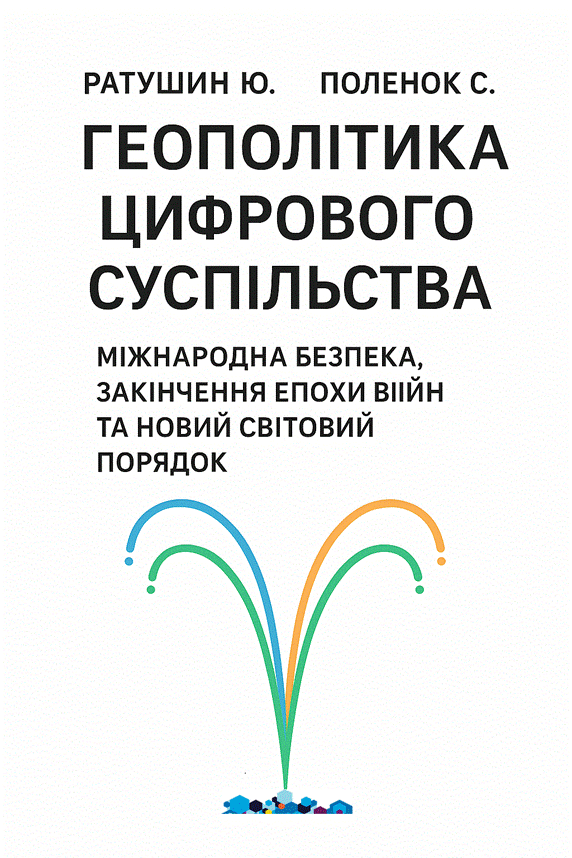
Yurii Ratushyn, Serhii Polenok
Geopolitics of the Digital Society
"International Security, the End of the Era of Eternal Wars,
and the New World Order"
Summary
Annotation
The book “Geopolitics of the Digital Society: International Security, the End of the Era of Wars, and the New World Order” explores how the digital age is transforming global relations, state policy, the economy, and social processes.
The authors propose a unique project of digital civilization that enables humanity to overcome the deepening global crisis pushing the world toward conflict, and to prevent a world war through innovative instruments — including the Digital Institutional Platform, digital law, digital citizenship, and the civic passive income.
The book covers the ideological and political foundations of the digital society, the global economy, sustainable development and adaptation to climate threats, migration challenges, security, international cooperation, and Ukraine’s role as a stronghold of digital geopolitics and comprehensive peace — marking the end of the era of perpetual wars.
Who this book is for:
For statesmen, international experts, policymakers, scholars, analysts,
business representatives, and all those interested in digital transformation,
global security, and the new world order.
It offers a new paradigm of world order — one in which law, ethics, and technology together form a stable, just, and sustainable digital future.
The book was developed based on a knowledge framework created by the authors in ChatGPT at https://chatgpt.com/c/6871f69c-08f4-8010-9f05-0596e998eb5f, which enabled them to integrate up-to-date analytical data, conceptual models, international practices, and acquired insights in the fields of digital society and global security.
Contents
Introduction
· From the Authors
· The Digital Era as a New Phase of Geopolitics
· The Ukrainian Context
· The Euro–American Context
· The Chinese Context
Part I. Civilizational Foundations
- Transformation of Sovereignty: From the State to the Individual
- The Eternal Patterns of Freedom, Equality, and Justice
- Civilism and Civilitary Relations
- The Digital Society and the Global Evolution of Law
Part II. The Civilism of the Digital Society (Ideology and Politics)
- Modern Political Movements: Left, Right, Liberal, Conservative, and Digital Civilism
- Civic Passive Income: Principles and Connection with Digital Property
- Social Responsibility of the Digital Person and Digital Citizenship
- The Impact of Digital Civilism on National and International Policy
- The Balance of Freedom, Equality, and Justice in Digital Ideology
Part III. The Polycentric Ecosystem of the Digital Society: The Geopolitics of Digital Space
- The Digital
Institutional Platform as a Foundation of Self-Organization
(Replacing the “instrument of power” — emphasizing the system-forming rather than coercive role) - Polycentric
Institutions and Neuro-Polycentrism
(Description of a new level of multipolar governance within digital civilization) - Digital Law
and Borderless Jurisdiction
(Formation of a legal system operating in the global digital space) - Neurochain,
Digital Contracts, and New Forms of Power
(The impact of technologies on political and legal mechanisms and governance structures) - Digital
Currency and the Geopolitics of Financial Flows
(New rules of the global economy, redistribution of resources, and financial sovereignty)
Part IV. Economic Dynamics and Global Crises
- Post-Industrial Economy and Energy Independence
- Kondratiev Waves and the Global Crisis of Industrialism
- Social Processes and the Satisfaction of Basic Needs
- Sustainable Development and Adaptation to Climate Threats
- Addressing Migration Challenges in the Digital Era
Part V. Security and World Order
- War,
Diplomacy, and Law: Three Paths to Resolution.
A Mathematical Model of Russia’s War against Ukraine from the Perspective of Innovative Weapons.
A Conceptual-Mathematical Model of Transition from the “Chronic Conflict” Regime to the “Stable Self-Organization” Regime. - The
International Hub for Sustainable Development Project Management:
A Conceptual-Mathematical Model of Hub Dynamics. - Digital Law as a New Architectonics of Peace
- Global
Challenges and Prevention of Climate Catastrophes:
Resources, Innovation, Adaptation.
Numerical Example: A Model for Preventing Climate Catastrophes through Neurochain
Part VI. The Ukrainian Dimension
- Ukraine as the Stronghold of Digital Geopolitics
- Ukraine’s Civilizational Mission in Shaping the New Security System
- Roadmap for the Ukrainian Digital Civilizational Project
Part VII. The Formula of Comprehensive Peace
- Freedom
Limited by Equality and Justice:
Mathematical Dynamics of the Digital Institutional Platform (DIP) Model,
Where Freedom Is Limited by Equality and Justice - The
Geopolitics of Algorithms: Ethics and Digital Democracy.
Mathematical Dynamics of the DIP Model,
Where Freedom Is Limited by Equality and Justice - Institutional-Engineering Regulation of the World Order
- Law as the Only Path to Ending Wars
Part VIII. Why China and the Russian Federation Will Be Compelled to Join the Creation of the New System of International Security
- Mathematical
Model (Illustrative and Analytical) Formalizing
the Economic Collapse of States (China, Russia) in Case of Non-Participation
in the DIP / International Hub Project - Explanation
of the Steps to Prevent the Collapse of Russia and China
Should They Refuse to Participate in Building the New System of International Security
Conclusions
· Geopolitics of the Digital Society as a New Paradigm
· Ukraine’s Contribution to the Global Future
· An Open Address to the World
Appendices
· Glossary of Digital Society Terms
· Agreement and Charter of the Hub
Introduction
From the Authors
We live in a world rapidly approaching its own limits. The global crisis is no longer a threat of the future — it is the reality of the present. Wars, ecological disasters, the breakdown of social bonds, and universal distrust all testify that the industrial system which once propelled humanity forward is now leading it to the brink.
The old world has exhausted its resources. No reform or modernization can save it any longer. Everything today called “renewal” merely accelerates the spiral of global collapse. The harder we try to revive industrialism, the deeper we sink into chaos.
Therefore, we proclaim: humanity can emerge from the global crisis only through the birth of a new dynamic that transcends the old paradigms. This is not a cosmetic adjustment of the industrial model — it is a fundamentally new movement forward. This dynamic can be created only by the digital society, which possesses its own ideology, its own institutions, its own economy, and its own politics.
We call this ideology the civilism of the digital society. It grows from three eternal patterns — freedom, equality, and justice. Yet, unlike traditional political movements — left, right, liberal, or conservative — civilism is not trapped in a struggle for power. It opens a space for new social relations, where digital property and civic passive income become the foundation of fair resource distribution, and digital citizenship becomes a new form of political participation.
The politics of the digital society is a politics of a new order — one that does not divide the world into winners and losers but creates the conditions for global equilibrium. Its instruments are digital law, polycentric institutions, digital currency, neurochain, and the Digital Institutional Platform (DIP). Its goals are not expansion and control but sustainable development, security, equitable distribution of wealth, and the creation of a world without wars.
In today’s crisis, the only way forward is through a new dynamic — through the politics of the digital society, driven by inclusion, innovation, and polycentrism. Only such politics can close the divides created by the industrial economy:
·
between rich and poor,
· between center and periphery,
· between power and society,
· between access to knowledge and new digital barriers.
This book is both our manifesto and our roadmap for transition. It is both our appeal and our guide.
· In Part II, we present the ideological and political
foundations of the civilism of the digital society.
· In Part III, we analyze the new geopolitics — from digital law to
global financial flows.
· In Parts IV–V, we examine the economy, climate challenges, migration
issues, and the architecture of security in the digital age.
· In Parts VI–VII, we propose the Ukrainian dimension and the formula
of comprehensive peace — as a path not only for one nation but for all
humanity.
We believe this book is not merely a study or theoretical exploration. It is the only coherent project today that offers a way out of the global crisis. It is an appeal to politicians, intellectuals, citizens, and entire nations: the old world is doomed — it is time to build a new one, the world of the digital society founded on freedom, equality, and justice.
Conclusion
The authors of this book consistently and convincingly argue that the industrial system has exhausted itself and can no longer overcome global challenges — wars, social inequality, ecological collapse, and the destruction of trust. Any reform within the old model only deepens the crisis.
The only way out lies in a new dynamic — the politics of the digital society, grounded in the ideology of civilism, in the three eternal patterns of freedom, equality, and justice, and realized through digital property, civic passive income, polycentric institutions, and the Digital Institutional Platform.
This vision is not utopian; it presents a concrete roadmap for transition, where the driving forces are inclusion, innovation, and polycentrism. The book positions itself as a manifesto and the only comprehensive project offering an exit from the global crisis — addressed to states, international institutions, and citizens of the world.
Начало формы
The Digital Era as a New Phase of Geopolitics
The digital era is not merely a continuation of the industrial age — it opens an entirely new vector of development in international relations and law. The classical model of state sovereignty, based on territoriality, military power, and control over resources, is being replaced by a new paradigm of polycentricity.
1. International Law and Polycentricity
Contemporary international law increasingly faces challenges that transcend national jurisdictions. Cyberspace, artificial intelligence, digital assets, and global networks cannot be governed by classical principles of exclusive state control. This creates a legal vacuum that is gradually being filled by mechanisms of polycentric governance — multi-level structures where states, international organizations, corporations, communities, and even digital persons interact.
The law of the future is becoming more networked and inclusive:
- Networked — implying interconnection between diverse legal and technological systems;
- Inclusive — requiring participation not only of states, but also of civil society, business, technological platforms, and AI as instruments of social organization.
Within this logic, a digital civil society is emerging — one that transcends the traditional “state–citizen” model and acquires the features of a global social contract.
2. Technological Capabilities and Artificial Intelligence
Technologies
— particularly artificial intelligence, neural networks, and blockchain — are
not merely tools of economic development but foundations for constructing a new
social order.
Whereas in the industrial age technology was an instrument of state power, in
the digital era it becomes the basis of legitimacy for new political and
legal models.
Artificial intelligence can model normative processes, optimize governance mechanisms, and design algorithms for collective decision-making. This means that in the digital phase of geopolitics, politics is no longer an exclusively human prerogative — it becomes a co-creation between humans and technology.
3. The United States, China, and Global Competition in the Digital Sphere
The geopolitical reality of the digital era is already defined by two poles — the United States and China.
- The United States relies on the private sector and the global dominance of digital corporations. Its model spreads influence through technology giants (GAFA), which have effectively become new actors in international relations. Yet the U.S. lacks a comprehensive vision of digital society as a political model — digitalization is perceived mainly as an extension of the market and a tool of geopolitical power.
- China, conversely, adheres to a model of centralized digital control. Its digital infrastructure functions not only as an economic but also a political pillar of state authority. The system of “digital surveillance” and social credit exemplifies how technologies are used to strengthen vertical power rather than to build an open digital society.
Both models contain a strategic gap: the U.S. focuses on markets, China on control — but neither offers an inclusive digital society founded on freedom, equality, and justice.
4. The Vector of Digital Civil Society Development
The true way out of the global crisis lies in forming a digital civil society as a new phase of global politics. Its foundation is the polycentric model, in which:
- the Digital Institutional Platform (DIP) eliminates the divides of the industrial economy;
- innovation and inclusion become the cornerstones of international law;
- artificial intelligence and technology ensure balance between global interaction and local autonomy;
- law transforms into a form of the next-generation global social contract.
In this sense, the digital era is not merely a new phase of geopolitics — it marks a civilizational transition, where peace, security, and development are no longer determined by military or economic power, but by the quality of institutions capable of uniting humanity through a new dynamic of trust and cooperation.
5. A New Global System of International Security
The industrial age produced a security system based on military-political blocs, balance of power, and deterrence. However, this system has proven incapable of preventing local wars, terrorism, cyber-threats, and the crisis of trust among nations. It has itself become a source of global instability.
The digital era demands the creation of a new architecture of international security, grounded not in rivalry but in polycentric cooperation. Its defining features are:
- Security as a global public institution — not a privilege of the powerful, but a right of every person, community, and state;
- The Digital Institutional Platform (DIP) as the technical and legal foundation for transparent mechanisms of control, prevention, and conflict resolution;
- Integration of artificial intelligence for risk monitoring, crisis forecasting, and the development of neutral, bias-free solutions beyond national politics;
- Law as a new instrument of peace, ensuring balance between freedom, equality, and justice in the digital realm;
- A global mechanism of inclusion, granting access to decision-making not only to states but also to international organizations, corporations, communities, and digital citizens.
Such a security system does not merely modernize the old model — it replaces it. It marks a transition from an age of deterrence and fear to an age of trust, institutional partnership, and peace-driven innovation.
Начало формы
6. The Digital Order for Sustainable Development: Integrating the SDGs, the Global Pact, and the Digital Protocol
The modern world faces not only ecological and economic crises but also a crisis of global coordination and political legitimacy. Achieving the 17 UN Sustainable Development Goals (SDGs) is possible only through a new institutional dynamic that unites technology, law, and polycentrism within the digital society.
1. The Global Pact and the Digital Protocol
The Digital Protocol is a legal-technological mechanism for implementing global political agreements within the digital domain. It provides:
- monitoring and enforcement of Sustainable Development Goals;
- automated interaction among digital persons, Polycentric Institutions (CPIs), and sub-platforms of the Digital Institutional Platform (DIP);
- legitimization of decisions through cross-signals and the neurochain.
2. Institutional Foundation — Polycentric Institutions (CPIs)
Each digital person possesses their own CPI as the core of their digital sovereignty. Through the CPI, individuals gain:
- access to digital property;
- participation in social passive income, reflecting a fair distribution of resources;
- coordination of actions with other CPIs and sub-platforms within the DIP to achieve the SDGs.
3. Digital Contracts and Cross-Signals
Digital contracts act as adaptive, real-time legal instruments integrated into the neurochain. They ensure:
- compliance with the principles of civilism in the digital society;
- transparent and automated fulfillment of obligations;
- interaction among CPIs without centralized control.
Cross-signals serve as markers of legitimacy and communication triggers for implementing both global and local sustainable development programs.
4. Digital Property and DIP Currency
These categories constitute the legal and economic foundation of the new order:
- Digital property allows each person to personalize their share of global digital assets;
- The DIP digital currency enables direct, transparent, and secure transactions linked to the achievement of the SDGs.
5. Inclusion, Innovation, and Polycentrism
The new digital order is built upon the principles of:
- Inclusion — every digital person has access to fundamental rights, income, and participation in governance processes;
- Innovation — automated systems and artificial intelligence ensure efficient resource management and adaptive governance;
- Polycentrism — the multiplicity of institutions and sub-platforms ensures decentralized decision-making and replication of successful patterns globally.
6. Implementation and Scaling
The use of the Digital Protocol and polycentric mechanisms enables the creation of a sustainable, replicable, and scalable system for achieving the SDGs — one that operates independently of centralized structures or state control.
This forms the foundation of a new system of global security and cooperation, where rights, resources, and responsibilities are distributed fairly, automatically, and transparently.
Начало формы
7. The International Hub for Sustainable Development Project Management as an Intersystemic, Independent Organization
In the digital age, global politics transcends traditional state structures and classical governance systems. Within this context, the creation of the International Hub for Sustainable Development Project Management represents a new type of intersystemic, independent organization — one capable of coordinating resources, technologies, and projects on a global scale, beyond the boundaries of individual states.
The Hub integrates:
· Digital Polycentric Institutions (DPIs) that ensure the autonomy of digital persons, the right to digital property, and participation in collective processes;
· The Digital Institutional Platform (DIP) as an environment for neuro-adaptive governance, digital contracts, and cross-signals;
· Artificial intelligence mechanisms that automate the coordination of sustainable development projects and adapt strategies in real time.
The International Hub is not subordinated to any state or corporate system and operates on the principles of:
· Inclusion, ensuring the participation of digital persons and sub-platforms from different countries;
· Polycentrism, coordinating multiple institutions without centralized control;
· Sustainability and security, directing projects toward achieving global Sustainable Development Goals (SDGs), a new system of international security, and digital harmony.
In global politics, the Hub functions as an instrument for shaping a new system of international security, capable of bridging the gaps of the industrial economy, ensuring the fair distribution of digital resources, and coordinating the interaction of states, communities, and digital persons within the framework of the civilism of the digital society.
Conclusion
The digital era opens a fundamentally new vector for the development of international relations and law. The traditional model of state sovereignty gives way to polycentricity, where states, international organizations, corporations, communities, and digital persons interact within networked structures.
Technology and artificial intelligence become not only instruments of the economy but also the foundation of new legitimacy and collective decision-making. Contemporary global challenges — including cyberspace, digital assets, and crises of trust — demand the creation of inclusive, polycentric mechanisms capable of ensuring peace, security, and sustainable development.
In this context, the International Hub for Sustainable Development Project Management stands as an intersystemic, independent institution, capable of coordinating resources, technologies, and projects globally — forming a new system of international security and digital cooperation based on freedom, equality, and justice.
Начало формы
Ukrainian Context
Ukraine possesses a unique civilizational experience that combines individualism, deep cultural continuity, and exceptional achievements in science and technology. From the khutir tradition — a school of self-sufficiency and survival — to the collective capacity for self-organization, the Ukrainian tradition has developed an archetype of freedom and responsibility. This archetype is not merely historical but genetically inherited, reflecting a natural inclination among Ukrainians toward independent decision-making. It is this very feature that shaped Ukraine’s unique understanding of polycentrism, which has become the ideological and cultural foundation for building the modern digital society.
In the 20th century, this archetype was complemented by another fundamental factor — cybernetics, the science of control and governance, which achieved exceptional development and global recognition in Ukraine. The Ukrainian school of cybernetics, founded by academicians Viktor Glushkov, Mykola Amosov, Borys Malinovsky, and Kateryna Yushchenko, united traditional Ukrainian individualism with the universal scientific principles of managing complex systems.
Borys Malinovsky and his team created Europe’s first electronic computing machine (MESM, 1951), which opened the continent’s path to the digital age. Kateryna Yushchenko developed the world’s first high-level programming language for address-based data processing, laying the foundations of software engineering. Viktor Glushkov laid the groundwork for automated economic management systems, predicted the emergence of digital currencies, and even designed a national electronic governance system. Mykola Amosov, by combining medicine and cybernetics, pioneered biocybernetics and the modeling of complex living systems.
From authentic Ukrainian individualism to cybernetics as a science of governance stretched an evolutionary path that gave the world not just inventions but an entire school of thought. It produced more than one hundred thousand programmers, engineers, researchers, and scientists who formed the core of the global IT revolution. Unlike purely applied directions, the Ukrainian school of cybernetics focused on building systems of governance — what today we call the architecture of the digital society.
In the 21st century, cybernetics has evolved into the science of the digital society and artificial intelligence. It has become the foundation of a new global model for organizing humanity, where digital institutions, polycentric mechanisms, and ethical algorithms can replace the old system of military deterrence and geopolitical control. This is the basis of the New System of International Security — a new world order built not on the power of arms, but on the power of law, knowledge, and technology.
Therefore, the Ukrainian civilizational tradition and the Ukrainian school of cybernetics together lay the foundation for a global transformation that brings humanity closer to fulfilling the ancient prophecy inscribed on the United Nations building:
“And
they shall beat their swords into plowshares,
and their spears into pruning hooks;
Nation shall not lift up sword against nation,
neither shall they learn war anymore.”
(Isaiah 2:4; Micah 4:3)
Thus, Ukrainian individualism as the foundation of polycentrism and the Ukrainian school of cybernetics as the science of governance together form the basis of the digital society — a new epoch for humanity, one with the potential to abandon eternal wars and affirm comprehensive peace.
Conclusion
Ukraine has proven that the path out of crisis is possible only through a new dynamic. From khutir-based individualism to the school of cybernetics, from Europe’s first computer and programming language to today’s digital and AI solutions — our experience forms the foundation of the digital society.
Today, amid war, Ukraine is creating not only tools of defense but also the architecture of a new international security system — one based on polycentrism, inclusion, and justice. Ukraine is becoming not the periphery but the heart of global transformation — a living example of how, from the ruins of industrialism, a new epoch of peace is being born.
Euro-American Context
The personal computer became a symbol of individualism and digital freedom. It was the first tool that allowed a human being to feel like an independent subject in the new information world. In the 1970s, Stafford Beer, through the Cybersyn project in Chile, demonstrated that cybernetics could serve as a foundation for just and efficient economic governance, while Norbert Wiener laid the philosophical groundwork for service technologies that could become instruments of equality and development. However, in practice, these ideas in Europe and the United States took a different direction.
Today, the United States promotes Web 3.0—blockchain, decentralized applications, and the data economy. Yet the entire infrastructure is controlled by private corporations closely aligned with state interests. The main centers of power have become the tech giants—GAFA (Google, Apple, Facebook, Amazon)—as well as corporations like Palantir and Anduril, specializing in mass data analytics, military technologies, and global surveillance systems.
Such a model leads not to freedom, but to total algorithmic control.
- Data monopoly: Corporations construct a digital portrait of every person, using artificial intelligence to manipulate individual choices.
- Algorithmic coercion: Recommendation systems define the information agenda, creating an illusion of freedom that is, in fact, tightly managed.
- The military-digital complex: Companies like Palantir integrate data analysis into military operations, while Anduril develops autonomous weapons systems—laying the groundwork for a new arms race.
The Euro-American legacy in digitalization is increasingly detached from the timeless values of freedom, equality, and justice. Instead, it focuses on deepening global control, strengthening corporate authoritarianism, and escalating geopolitical tension. This trajectory does not resolve the crisis—it exacerbates it, turning the “vortex” of global instability into a prelude to world conflict.
As a result, we witness a departure from the original ideals of the digital age. Rather than becoming a space of inclusion and development, technology in the West has evolved into an architecture of domination—where freedom is reduced to a marketing slogan, equality replaced by algorithmic control, and justice subordinated to the interests of shareholders and national corporations.
Conclusion
The Euro-American model of digitalization, which began as a space of freedom and individualism, has transformed into an architecture of global control. Its driving forces—corporate authoritarianism, the military-digital complex, and algorithmic coercion—have replaced the eternal values of freedom, equality, and justice with the pursuit of corporate profit and state dominance.
Chinese Context
China’s approach to the digital age grows from deep civilizational roots, where an authoritarian tradition and Confucian philosophy have enshrined the idea of the individual’s subordination to a higher order. Whereas in European culture the philosophy of the Enlightenment placed human freedom at the center, the Chinese paradigm has formed around the notion of harmony—achieved through hierarchy and strict adherence to rules. In this logic, the digital network is not a space of autonomy but an instrument of social organization, where power acts as the ultimate arbiter.
One of the symbols of China’s new influence is Jack Ma’s business project — the Alibaba platform and its related services. They demonstrate how China’s “soft power” spreads through economic integration, e-commerce, and digital services, creating dependence across entire regions on Chinese technologies and standards. At the same time, the state maintains tight control over such tools, turning them into instruments of strategic influence. Thus, the commercial ecosystem becomes both a channel for disseminating China’s governance model and a means of geopolitical expansion.
A key element of this model is algorithmic control in its purest form. It is implemented through the social credit system, in which artificial intelligence analyzes each individual’s financial, behavioral, and social data, generating a dynamic “trustworthiness” score. Added to this is real-time video surveillance: integrated cameras with facial recognition technologies (such as Face++) synchronize with databases that instantly update citizens’ profiles. The system automatically imposes sanctions — a person with a low rating may lose the right to buy a ticket, take out a loan, or even enroll their child in school. Ultimately, digital citizenship becomes a license to exist—one that can be revoked with a single click.
Unlike Western practices, where digital control is often presented under the guise of “consumer protection” or “counter-terrorism,” in China, control is fully integrated into the state system. Social scoring, transaction and movement monitoring, and information flow regulation are perceived as an organic extension of state authority, not as violations of human rights. There is no illusion of the “free individual” here—the digital network operates as an instrument of state discipline.
Conclusion
China is constructing a model of “digital governance” that combines artificial intelligence, big data, a social credit system, and strict control of information flows. This model is increasingly being offered to the world as an alternative to the liberal order but, in practice, replaces civic rights with algorithmic regulation. It embodies a vision of the digital sphere as a tool of state power—one capable of extending beyond China’s borders and influencing the global security architecture.
General Conclusion
The world’s models of digitalization—the Euro-American and the Chinese—represent two extremes: corporate authoritarianism and state algorithmic control. Both deepen the global crisis, transforming the digital era into a battleground for dominance and total influence.
The Ukrainian context stands in principled contrast. By combining its historical individualism and tradition of polycentrism with a powerful cybernetics school and modern advances in IT and AI, Ukraine offers a new dynamic of social development. This dynamic is founded not on control, but on the principles of freedom, equality, and justice—forming the foundation for the Digital Society and a new system of international order.
Ukraine can become a center of global renewal, where digital technologies serve not as instruments of subjugation but as tools of inclusion, sustainable development, and the creation of a world free from perpetual war. It is here that an alternative is emerging—one that can save the international community from descending into the abyss of conflict and open the path toward comprehensive peace.
Summary
1. Introduction. The Birth of the Digital Era
The world is entering a phase where digital technologies are no longer just tools — they have become the environment of human existence, a new space of social, economic, and political reality. We no longer merely use technologies — we live within them.
This book was born as a response to the key question of the 21st century:
How can civilization survive in an age when information has become the main resource, and trust — the main currency?
The authors offer not only an analysis of the technological transition but a holistic concept of a new social order — digital civilization, in which the interaction between humans, artificial intelligence, and institutions shapes a new ethics, a new economy, and a new system of security.
The digital age is not just another technological revolution — it is a civilizational shift: a transition from societies of coercion to societies of self-regulation, from centralized hierarchies to polycentric networks of trust, from power balances to value balances.
This transition is the core subject of the book.
“Humanity is not facing a choice of technologies — it is facing a choice of what kind of human being to be in the digital world.”
The introductory chapters present the main thesis of the work: the digital society is not a continuation of old state models — it is the birth of a new type of civilization, founded on ethical algorithms, digital property, and collective intelligence.
This transformation demands a new geopolitical vision — because digital borders no longer coincide with geographical ones, and power increasingly belongs not to those who control territories, but to those who control flows of data, meanings, and interactions.
2. The End of the Industrial World and the Beginning of Digital Civilization
The industrial era left behind a vast legacy — imperial states, capital markets, armies, and energy corporations. Yet it also created a global crisis, in which economics, politics, and ecology have merged into a single knot — the crisis of trust.
In the 20th century, humanity fought over
resources; in the 21st — it struggles over meanings.
That is why a new type of order is now forming — a digital one, where
the main assets are no longer oil or gold, but data, knowledge, reputation,
and digital identity.
The authors call this transformation the birth of digital civilization — a system in which social processes are governed not by commands from above, but by digital patterns that reproduce the ethical principles of freedom, equality, and justice. Laws lose their coercive nature — replaced by algorithms of coexistence created through the ethical consensus of communities.
The central element of this new reality is the Digital Institutional Platform (DIP) — a universal system for coordinating social, economic, and political processes. It functions like the neural network of humanity, where each citizen becomes a digital person, and every action — a signal within a shared field of mutual responsibility.
“The DIP is neither a state nor a corporation. It is an institutional form of a new order — a digital society where intellect, law, and morality are united as one.”
Thus, digital civilization is not a rejection of the state — but its evolution. The state gradually transforms into a polycentric structure, where power is not concentrated in the hands of a few, but distributed among a multitude of institutions — Digital Polycentric Institutes (DPIs) — that operate on the principle of neural interaction.
In this new model, freedom and responsibility are balanced, and global development is subordinated to a shared goal — the survival of civilization through fair resource distribution and sustainable peace.
Within this context, Ukraine emerges not merely as a territory of struggle between the old and the new world, but as a civilizational laboratory — a space where the principles of digital ethics, global security, and new political culture are being born.
3. Geopolitics of the Digital Society: New Players, New Rules
The geopolitics of the digital age is taking shape beyond traditional state borders. While industrial geopolitics was defined by territory, resources, and military power, the geopolitics of the digital society is based on control over flows of information, data, and algorithms that shape societal behavior.
New centers of influence are emerging not as states, but as digital ecosystems — global networks, platforms, cloud-based institutions, and analytical systems capable of shaping public opinion, directing economic flows, and even determining political decisions.
In this context, traditional states lose their monopoly on power, as governance mechanisms shift into the digital space, where different laws operate — not coercive ones, but institutional-informational rules. The main instruments are no longer armies, but informational influence; not territory, but virtual legitimacy.
The book defines this process as a transition from geopolitics of control to geopolitics of interdependence. On the global stage, full autonomy no longer exists: any society becomes part of a network in which data, resources, energy, and even moral values circulate among multiple centers of influence.
Such a transformation requires new principles of international governance based on digital law, neuro-political balance, and value alignment, rather than mere interests. This is precisely the purpose of the Digital Institutional Platform (DIP), which offers a universal system for coordinating the actions of states, businesses, society, and artificial intelligence within a unified environment of global responsibility.
4. Digital Institutional Platform (DIP): The Heart of the New Governance System
The Digital Institutional Platform (DIP) is the central element in the architecture of digital civilization. It does not replace the state but creates a supranational level of coordination, where algorithms, artificial intelligence, and digital contracts ensure transparency, accountability, and resilience in socio-economic processes.
The DIP operates on the principle of neural-network governance: instead of a vertical hierarchy of subordination, a system of polycentric connections is formed, in which each participant enjoys autonomy while remaining integrated into the overall logic of collective development.
Its functions include:
· Coordination of international sustainable development programs through digital contracts;
· Creation of a unified legal framework for digital property;
· Formation of a global security system based on algorithms of trust and shared ethics;
· Institutional management of the economy based on fiscal neutrality, i.e., ensuring a balance between development and social justice.
Within the DIP, every digital person has legal capacity and responsibility, ensured through Digital Polycentric Institutes (DPIs) — self-regulating structures that act as autonomous nodes in the system. DPIs function as miniature governance institutions capable of making decisions within their competence without the need for centralized control.
This model establishes the foundation for a new type of digital democracy — not formal, but functional, where legitimacy is based not on political procedures, but on efficiency, transparency, and ethical alignment of all participants’ actions.
5. Polycentric Institutes and the New Architecture of Power
In the era of digital civilization, power ceases to be a static category. It becomes a dynamic network of interactions, where decision-making centers are distributed among numerous nodes — states, communities, digital institutes, and artificial intelligences.
Digital Polycentric Institutes (DPIs) represent a new form of social organization, combining principles of self-governance, ethical oversight, and technological transparency. Each DPI possesses its own local competence — in economics, security, ecology, or culture — while remaining part of the overall digital system, where decisions are synchronized through consensus algorithms.
Within this architecture, power becomes multiplicative, and governance adaptive. There is a transition from centralized control to neuro-political interaction, where decisions are made through data analysis, collective intelligence, and continuous alignment between institutes.
A key outcome of this transformation is a new understanding of sovereignty. Whereas in the traditional world sovereignty belonged to the state, in the digital society it is distributed among individuals, communities, and artificial intelligence. This gives rise to the concept of personal sovereignty, where each participant has the right to govern their own data, digital identity, and share of collective intelligence.
Polycentric power does not diminish responsibility — on the contrary, it strengthens it, as each decision leaves a digital trace, and every action is recorded as an ethical or unethical replica. In this way, ethics becomes the foundation of new politics, and digital trust its main instrument.
6. Digital Institutional Platform: Architecture of a New World
The world as we knew it relied on vertical institutions of power formed during the Industrial Revolution. The digital age, however, creates a fundamentally different model of social organization — the Digital Institutional Platform (DIP).
The DIP is not a government portal nor another technocratic utopia. It is a new form of civilizational infrastructure, in which every digital person acts as the bearer of their own sovereignty, while artificial intelligence serves as a tool for their Polycentric Institute (DPI).
In this system, AI is not authority and does not act independently — it
only executes the ethical algorithms developed by the institute. The digital
person who owns the DPI bears joint legal and moral responsibility for
its actions.
The DIP has no central control. Instead of a vertical hierarchy of power, there is a network of polycentric institutes (DPIs) interacting like neurons in a single ethical neurochain — the global consciousness of humanity.
Each DPI is a node balancing ethics, law, and economy; its structure
forms a new governance logic where digital replications replace bureaucratic
commands, and legal patterns replace state regulations.
Thus emerges the ethical-algorithmic governance model, in which decisions are made not by coercion, but by adherence to principles of balance:
Freedom, limited by equality and justice — not a slogan, but a formula for sustainable digital order.
This model replaces the old paradigm of “state sovereignty” with a new one — personal sovereignty, where responsibility becomes the foundation of freedom.
7. Polycentricity as a Principle of Life
Digital society has no single center. That is its strength. Polycentricity is not just technical decentralization, but a new type of global thinking, in which power is distributed among intelligences, institutions, and communities. Each polycentric institute functions as a self-regulating organism, adapting to local and global conditions.
This gives rise to a neuro-polycentric world, where interaction is based not on command but on insight; not on competition, but on the harmony of signals. This world needs no hegemons, because power no longer means domination — it means responsibility.
Polycentricity resolves the central crisis of modern geopolitics — the impossibility of reconciling global unity with local freedom. In the digital model, this contradiction dissolves: each node of the system is both independent and interconnected. Freedom ceases to be anarchy, and order is no longer dictatorship.
8. Civilism: A New Social Paradigm
Civilism is the core philosophy of digital society. It arises from a simple but profound idea: society is not the sum of people, but a system of relationships between freedom, property, and values.
In this system, a person is not subordinate to the state, but an active
bearer of civilizational rights; their freedom is limited only by equality and
justice.
Civilism unites what once seemed
incompatible — morality, technology, and economy. It transforms law into
a living system of signals, and ethics into active norms of digital
behavior.
Where courts once acted, algorithms of ethical balance now operate;
where hierarchy once ruled, a network of responsibilities now functions.
Civilism is not a utopia. It is the natural evolution of a society that has learned to see freedom not as a threat, but as a resource for peace.
9. Ukraine — the Center of Digital Geopolitics
Among the states standing on the threshold
of a new era, Ukraine has a historic mission — to become the center of
digital geopolitics and a laboratory for global transformation.
The war it is experiencing has become a catalyst for understanding: old
institutions are powerless against hybrid aggression, and therefore a new
system of international security is required — one based not on the power of
weapons, but on the power of structure.
Ukraine can become the space where the International Hub for Sustainable Development Projects is born, and at the same time — a new type of statehood built on the Digital Institutional Platform (DIP).
Here, digital diplomacy is forming, replacing war with communication,
and conflict with institutional balance.
For this reason, Ukraine’s experience of transition from survival to innovation is not only a national story, but a global civilizational process that opens the path to comprehensive peace.
10. A New International Security System — Architecture of Comprehensive Peace
The world in which security was based on deterrence is over. The balance-of-fear model — nuclear, economic, informational — no longer guarantees peace. It only postpones catastrophe.
The new era requires not new weapons, but a new architecture of trust.
Here emerges the concept of a new international security system — polycentric, ethical-digital, built on the DIP as a universal institutional platform for global coordination.
This system does not replace the UN or international law — it complements them with a digital layer of reality, creating a supranational space for communication, monitoring, arbitration, and preventive conflict management.
In this system, security is not a
product of force, but a function of mutual transparency.
Every project, every transaction, every digital institute has its own
institutional profile, enabling the prevention of manipulation, hidden threats,
data asymmetry, and undue influence.
In this logic, war becomes an ineffective form of communication, because conflict in digital space is easier to prevent than to win.
The polycentric security system operates on
the principle of “mutual ethical resonance”:
each participant not only protects their own interests but also maintains the
balance of others — because the loss of one link destroys the entire network.
This is not an alliance of states, but an alliance of responsibilities, where humanism becomes a strategic category once again.
11. From Global Chaos to Institutional Order
After the collapse of the unipolar model and the failure to establish balance among the USA, China, and the EU, the world has entered a post-hegemonic vacuum. No single state can unilaterally set the rules anymore. But digital civilization offers a new opportunity — the creation of order without domination, through a self-organized institutional system.
In it, power transforms into a function of compliance — not of who controls, but of who acts most accurately within the balance of freedom, equality, and justice. Thus emerges institutional equilibrium, where war has neither moral nor logical justification.
Ukraine, having endured aggression, becomes the space where this new security model is tested.
It teaches the world that victory is not in destroying the enemy, but in
restoring a system capable of eliminating the very possibility of war. This
is the practical philosophy of digital peace.
12. Ethics as the Operating System of Civilization
No technology is inherently good or evil — it all depends on the value system in which it is embedded.
Digital society cannot exist without an ethical-algorithmic core regulating the behavior of AI, digital institutions, and humans themselves.
In the traditional state, morality was a recommendation, and law was coercion.
In digital civilization, ethics becomes law, and law becomes the form of its implementation.
Here, freedom is not the right to do anything, but the duty to act within equality and justice.
This transforms morality into the infrastructure of society.
Every digital person bears full moral and legal responsibility for their AI.
AI is not an autonomous subject, but a tool for ethically enhancing the human — their mind, will, and ability to co-create the future.
Therefore, the main conflict of the 21st century is not a war between humans and machines, but a struggle for moral governance of algorithms.
13. Ukraine — a Testbed of Ethical Leadership
Digital geopolitics is not just about technology. It is about a new type of moral leadership.
Ukraine has already demonstrated that freedom can be stronger than fear, and truth can be more effective than propaganda.
Now it must take the next step: to transform the ethical experience of the struggle for freedom into an institutional system of digital peace.
The creation of the International Hub for Sustainable Development Projects is not merely a diplomatic initiative.
It is the practical implementation of digital civilization, in which every state, community, and individual is granted a place within a polycentric system of global coordination.
Here emerges a new geoethics — the ethics of responsible power, where security does not require armies, and justice does not require war.
14. Digital Civilization: The Formula for Comprehensive Peace
The world stands on the threshold of metamorphosis.
Old ideologies have exhausted themselves, national interests merge into planetary ones, and the future ceases to be a territory of struggle — it becomes a space of coexistence.
Digital civilization is the first attempt to structure this new order of mind, where technology serves not control, but development.
Its formula is simple, yet universal:
Freedom, limited by equality and justice — this is the form of comprehensive peace.
This is not a slogan — it is the algorithm of the era.
It transforms chaos into structure, ethics into law, and humanity into the center of universal balance.