CIVILISM - GLOBAL DIGITAL REPUBLIC
The new architecture of the world order and the development of a civil digital society
Comparison with the concept of "Technological Republic" (Alex Karp)
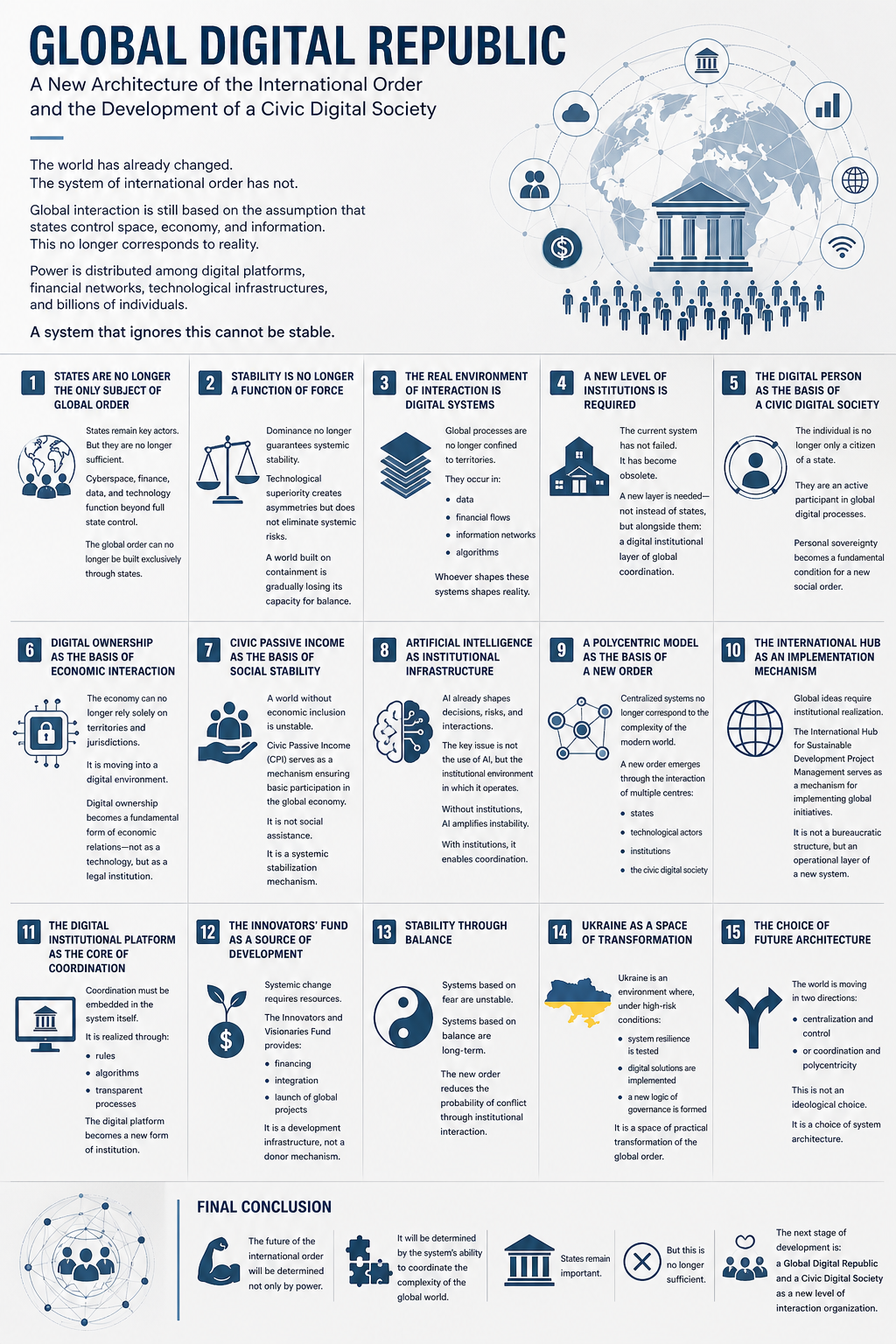
The world has already changed. The system of international order has not.
Global interaction is still built on the assumption that states control space, economy, and information. This no longer corresponds to reality.
Power is distributed across digital platforms, financial networks, technological infrastructures, and billions of individuals.
A system that ignores this cannot be stable.
1. CIVILIZATIONAL CONTINUITY AND INSTITUTIONAL LEGITIMACY
The Global Digital Republic is not a rupture with the existing international order, but its evolutionary continuation. The new digital layer is superimposed on states while preserving the historical continuity of institutions.
The modern world is shifting from a hierarchical model to a networked interdependence, where stability is defined not by force but by coordination and shared values.
Institutions remain the key mechanism of resilience even in times of crisis, but their role expands into the digital domain. Alongside them, a new dimension emerges — digital rights, digital sovereignty of the individual, and shared civilizational responsibility.
Technological progress, including artificial intelligence, becomes a shared infrastructure of humanity rather than an instrument of dominance.
In this context, the international order acquires a networked and polycentric character, where security, development, and stability are ensured through interdependent institutions and long-term responsibility toward future generations.
2. STATES ARE NO LONGER THE ONLY SUBJECT OF GLOBAL ORDER
States remain key actors, but they are no longer sufficient.
Cyberspace, finance, data, and technology operate beyond full state control.
The global order can no longer be built exclusively through states.
3. STABILITY IS NO LONGER A FUNCTION OF POWER
Dominance no longer guarantees systemic stability.
Technological superiority creates asymmetries but does not eliminate systemic risks.
A world built on deterrence is gradually losing its capacity for balance.
4. THE REAL ENVIRONMENT OF INTERACTION IS DIGITAL SYSTEMS
Global processes are no longer confined to territories. They take place in:
- data;
- financial flows;
- information networks;
- algorithms.
Those who shape these systems shape reality.
5. A NEW INSTITUTIONAL LAYER IS REQUIRED
The current system has not failed — it has become obsolete.
A new layer is required — not instead of states, but alongside them: a digital institutional layer of global coordination.
6. THE DIGITAL PERSON AS THE FOUNDATION OF CIVIL DIGITAL SOCIETY
An individual is no longer only a citizen of a state. They are an active participant in global digital processes that transcend territorial and jurisdictional boundaries.
The emergence of digital identity transforms the individual into a structural element of the global digital system, where participation, rights, and responsibilities are no longer exclusively mediated by nation-states.
Individual sovereignty becomes a fundamental condition for the formation of a new social order, where the person is recognized as an autonomous node within the global institutional network.
7. DIGITAL OWNERSHIP AS THE BASIS OF ECONOMIC INTERACTION
The economy can no longer be based solely on territorial jurisdiction and physical assets. It is increasingly shifting into a digital environment where value, exchange, and ownership are defined through distributed systems.
Digital ownership becomes a foundational legal and economic institution, enabling individuals and organizations to hold, transfer, and manage assets in a globally interoperable framework.
This transformation redefines property not as a physical construct, but as a programmable and enforceable digital right within institutional systems.
8. CITIZEN BASIC INCOME AS THE FOUNDATION OF SOCIAL STABILITY
A world without broad economic inclusion is structurally unstable. As automation and artificial intelligence reshape labor markets, traditional income mechanisms become insufficient.
Citizen Basic Income (CBI) emerges as a systemic mechanism ensuring baseline participation in the global economy. It is designed not as social assistance, but as a structural stabilization layer of the system.
CBI provides resilience against economic fragmentation and ensures continuity of civic participation in digital economic systems.
9. ARTIFICIAL INTELLIGENCE AS INSTITUTIONAL INFRASTRUCTURE
Artificial intelligence is already shaping decisions, risk structures, governance processes, and global interactions.
The central issue is no longer technological capability, but the institutional framework within which AI operates. Without institutional governance, AI amplifies systemic instability and asymmetry.
With properly designed institutions, AI becomes an instrument of coordination, predictability, and global system integration. It functions as infrastructural intelligence embedded in governance architecture.
10. A POLYCENTRIC MODEL AS THE FOUNDATION OF THE NEW ORDER
Centralized systems are no longer capable of managing the complexity of the modern global environment. The increasing interdependence of actors requires distributed governance structures.
The new order emerges through interaction among multiple centers of power and influence, including:
- States as sovereign institutional actors
- Technological platforms as infrastructural systems
- International and digital institutions as coordination layers
- Civil digital society as an autonomous participant in governance
This model replaces hierarchical control with systemic coordination and adaptive interdependence.
11. THE INTERNATIONAL HUB AS A MECHANISM OF IMPLEMENTATION
Global ideas require operational and institutional execution frameworks. Without implementation mechanisms, strategic concepts remain declarative.
The International Hub for Sustainable Development Project Management serves as such an implementation layer, translating global principles into coordinated, executable programs.
It is not a bureaucratic institution, but an operational system for managing complex transnational initiatives within a unified digital coordination environment.
12. DIGITAL INSTITUTIONAL PLATFORM AS THE CORE OF COORDINATION
Effective coordination in a complex global system must be embedded within the system itself. It cannot exist as an external supervisory layer.
The Digital Institutional Platform provides this embedded coordination through:
- rule-based governance frameworks
- algorithmic coordination mechanisms
- transparent and auditable processes
It represents a new institutional paradigm where governance is operationalized through digital infrastructure.
13. THE INNOVATORS’ FUND AS A SOURCE OF DEVELOPMENT
Systemic transformation requires sustained allocation of resources toward innovation and implementation. Without dedicated financing structures, institutional evolution remains incomplete.
The Innovators’ and Visionaries’ Fund provides:
- strategic financing for transformative initiatives
- integration of technological and institutional development
- support for large-scale global system deployment
It functions as a development infrastructure designed to accelerate systemic transition rather than a traditional donor mechanism.
14. STABILITY THROUGH BALANCE
Systems built on coercion, fear, or unilateral dominance are inherently unstable over time. They generate resistance, fragmentation, and systemic inefficiencies.
In contrast, systems based on balance, mutual constraint, and institutional coordination demonstrate long-term resilience.
The emerging global order reduces the probability of conflict not through deterrence alone, but through structured interdependence and institutionalized cooperation.
15. UKRAINE AS A SPACE OF TRANSFORMATION
Ukraine represents a real-world environment in which systemic transformation is being tested under high-intensity conditions.
Within this context:
- systemic resilience is stress-tested in real conflict conditions
- digital governance and infrastructure solutions are implemented under pressure
- new models of institutional coordination are experimentally validated
This positions Ukraine not only as a geopolitical actor, but as a practical laboratory of global systemic evolution.
16. THE CHOICE OF FUTURE ARCHITECTURE
The global system is evolving along two fundamentally different trajectories:
- centralization, control, and hierarchical concentration of power
- coordination, distribution, and polycentric systemic organization
This is not an ideological opposition, but a structural choice between competing models of global architecture.
The outcome of this choice will determine the long-term stability and adaptability of the international system.
CONCLUSION
The future of international order will not be determined by force alone.
It will be determined by the system’s ability to coordinate the complexity of the global world.
States remain important, but this is no longer enough.
The next stage of development is the global digital republic and the civil digital society as a new level of organization of interaction.