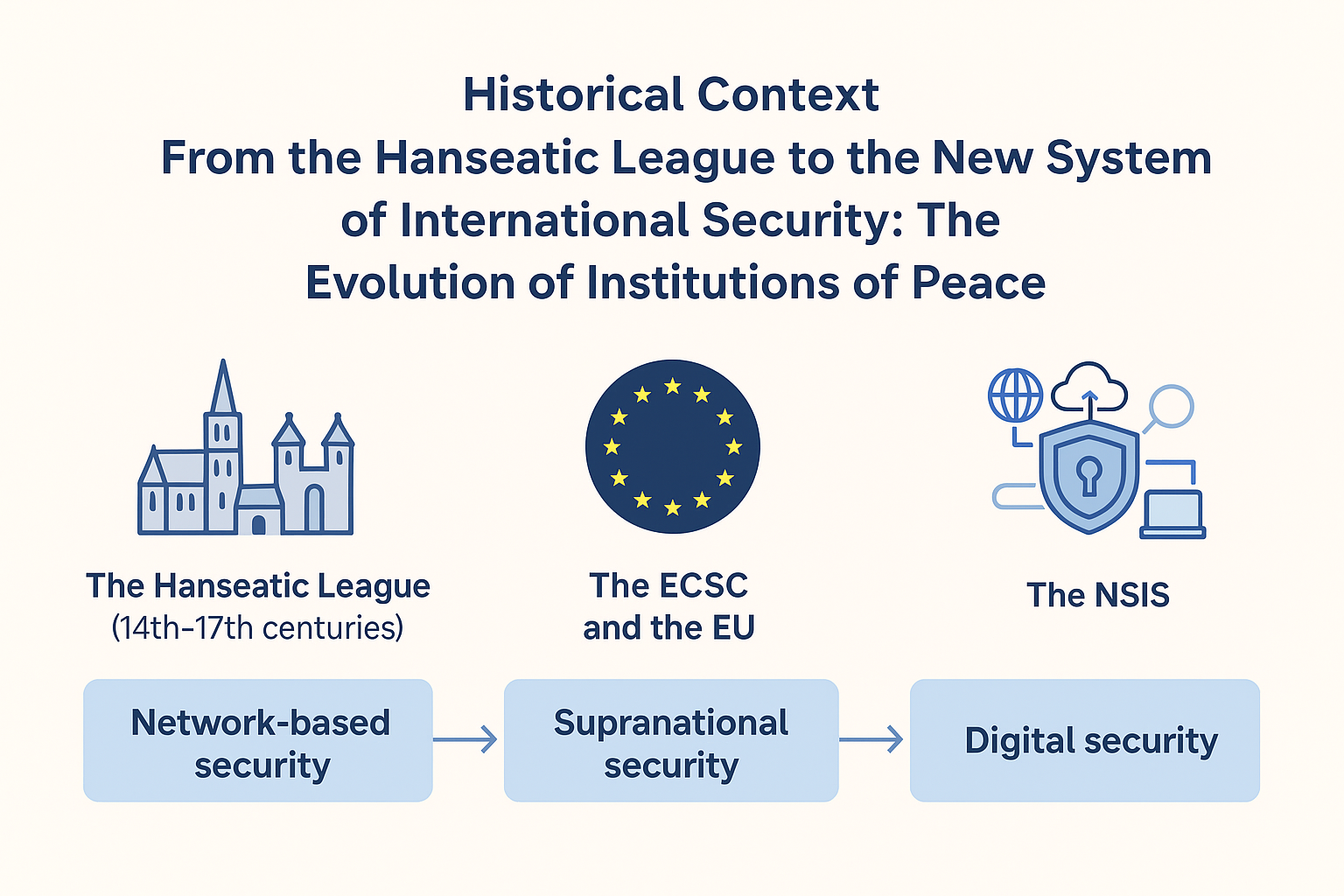
Human history demonstrates a clear pattern: lasting peace has never been achieved by force alone. It emerges through institutions that make war unprofitable - economically, socially, and politically.
- The Hanseatic League (14th-17th centuries) - a network-based association of cities securing trade;
- The European Coal and Steel Community -> the European Union - a supranational system eliminating war among European states;
- The New System of International Security (NSIS) - a global project structurally removing war as a policy instrument in the digital age.
Formed in 1356, the Hanseatic League existed for over four centuries, uniting up to 130 cities and influencing nearly 3,000 settlements through voluntary, horizontal cooperation.
- Voluntary membership without coercion;
- No centralized authority or sovereign;
- Horizontal governance instead of hierarchy;
- Legal equality regardless of size, language, or faith;
- Security through economic interdependence.
After World War II, Europe chose institutions over force. The ECSC placed coal and steel - the resources of war - under joint control, making war materially difficult and economically irrational.
The NSIS responds to existential risks of the 21st century by integrating security, human well-being, and planetary survival into a single digital institutional architecture.
- Shared governance of data, AI, and digital property;
- Polycentric Digital Institutions (PDIs);
- Civic Passive Income (CPI) as a stabilizer;
- Digital governance of climate adaptation.
| Criterion | Hanseatic League | ECSC / EU | NSIS |
|---|---|---|---|
| Level | Cities | States | Humanity |
| Resources | Trade | Coal & Steel | Data, Trust, Climate |
| Peace Mechanism | Reputation | Resource Control | Loss of Digital Access |
| Architecture | Horizontal | Supranational | Polycentric Digital |
For the first time in history, security is centered on the individual. Through digital identity, participation in the Digital Institutional Platform, and a guaranteed Global Public Dividend, peace becomes personally beneficial.
Economic networks -> Industrial peace -> Digital civilization of trust