PRINCIPLE OF FREEDOM:
ALGORITHMICAL CONSTRAINTS INSTEAD OF REGULATION
The new architecture of the global order
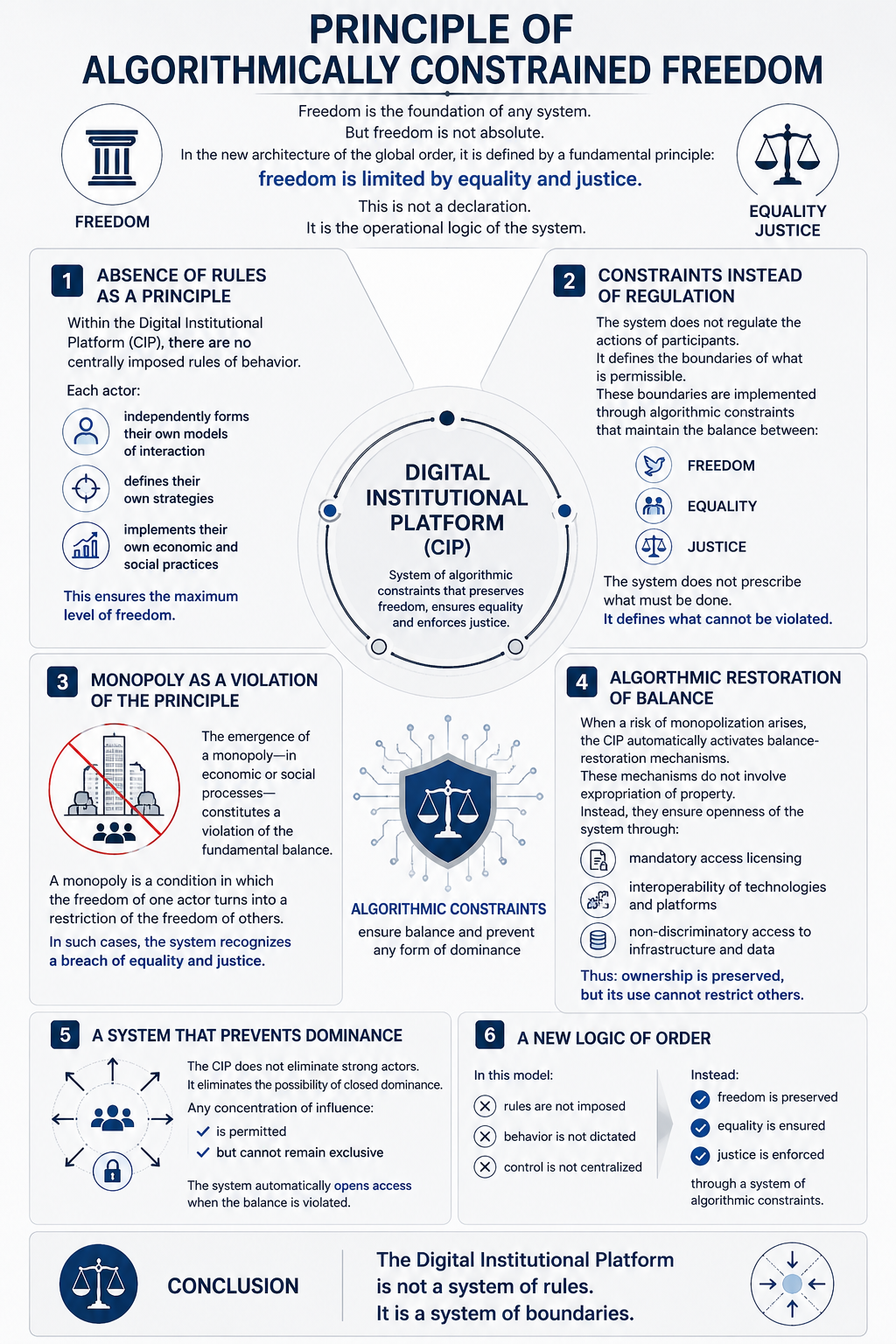
ALGORITHMICALLY CONSTRAINED FREEDOM
Freedom is the foundation of any system.
But freedom is not absolute.
In the new architecture of the global order, it is defined by a fundamental principle: freedom is limited by equality and justice.
This is not a declaration.
It is the operational logic of the system.
ABSENCE OF RULES AS A PRINCIPLE
Within the Digital Institutional Platform (CIP), there are no centrally imposed rules of behavior.
Each actor:
• independently forms their own models of interaction • defines their own strategies • implements their own economic and social practicesThis ensures the maximum level of freedom.
Constraints Instead of Regulation
The system does not regulate the actions of participants.
It defines the boundaries of what is permissible.
These boundaries are implemented through algorithmic constraints that maintain balance between:
- freedom
- equality
- justice
The system does not prescribe what must be done. It defines what cannot be violated.
Monopoly as a Violation of the Principle
The emergence of a monopoly in economic or social processes constitutes a violation of the fundamental balance.
A monopoly is a condition in which the freedom of one actor turns into a restriction of the freedom of others.
In such cases, the system recognizes a breach of equality and justice.
Algorithmic Restoration of Balance
When a risk of monopolization arises, the CIP automatically activates balance-restoration mechanisms.
These mechanisms do not involve expropriation of property.
Instead, they ensure openness of the system through:
- mandatory access licensing
- interoperability of technologies and platforms
- non-discriminatory access to infrastructure and data
Ownership is preserved, but its use cannot restrict others.
A System That Prevents Dominance
The CIP does not eliminate strong actors.
It eliminates the possibility of closed dominance.
Any concentration of influence:
- is permitted
- but cannot remain exclusive
The system automatically opens access when the balance is violated.
A New Logic of Order
- rules are not imposed
- behavior is not dictated
- control is not centralized
Instead:
- freedom is preserved
- equality is ensured
- justice is enforced
through a system of algorithmic constraints.
Conclusion
The Digital Institutional Platform is not a system of rules. It is a system of boundaries.